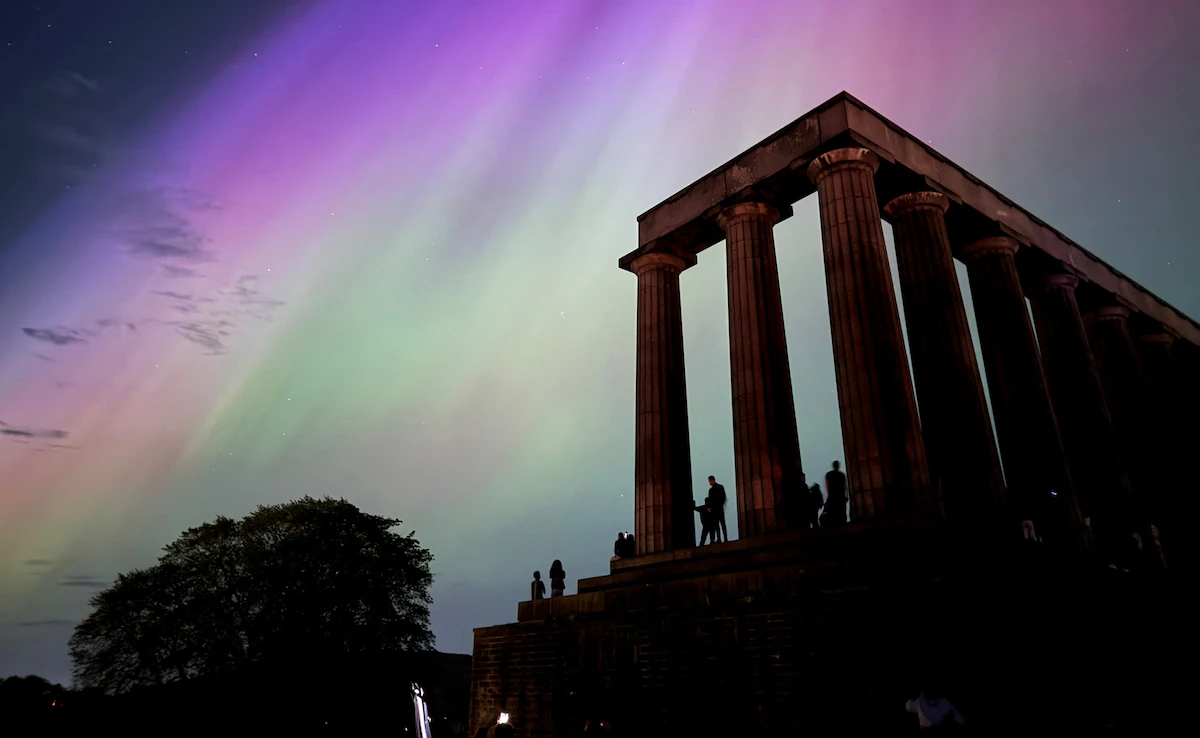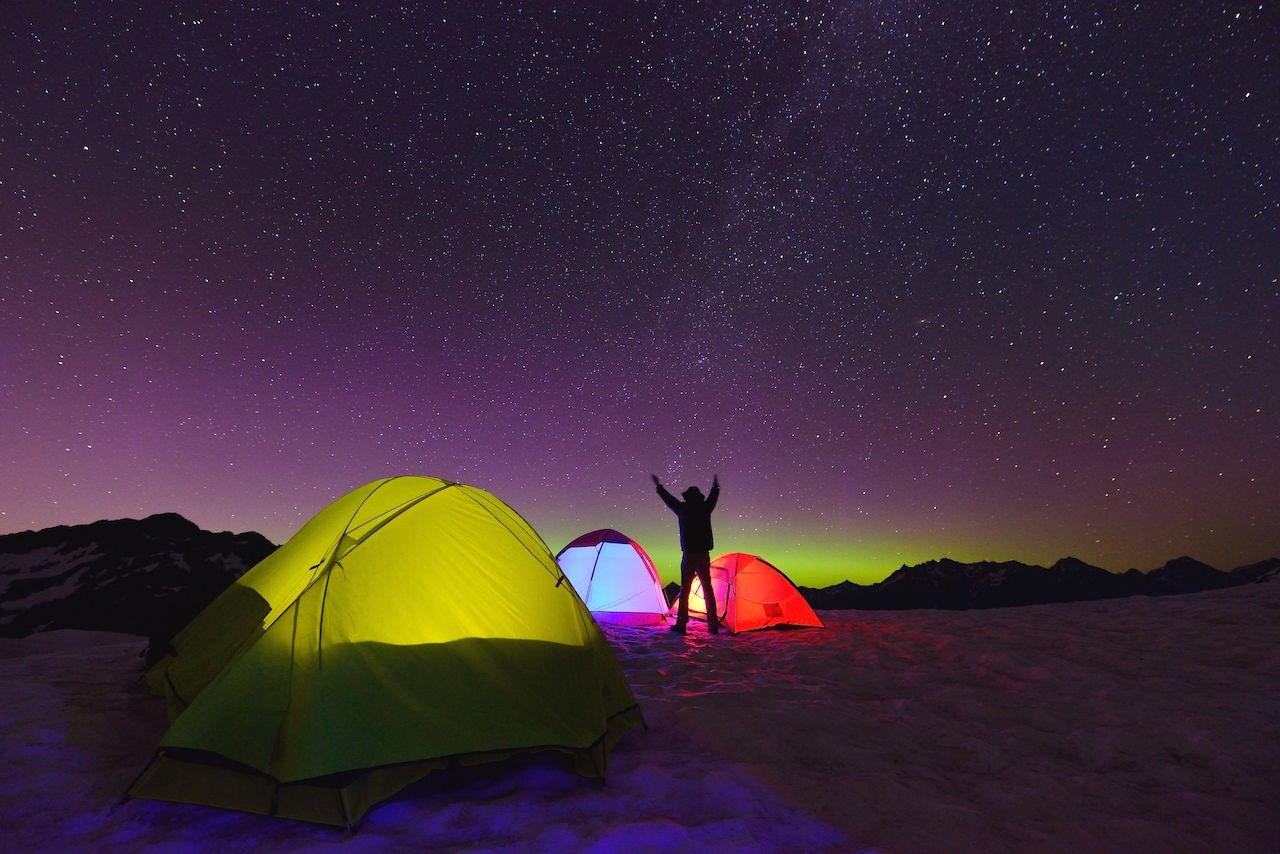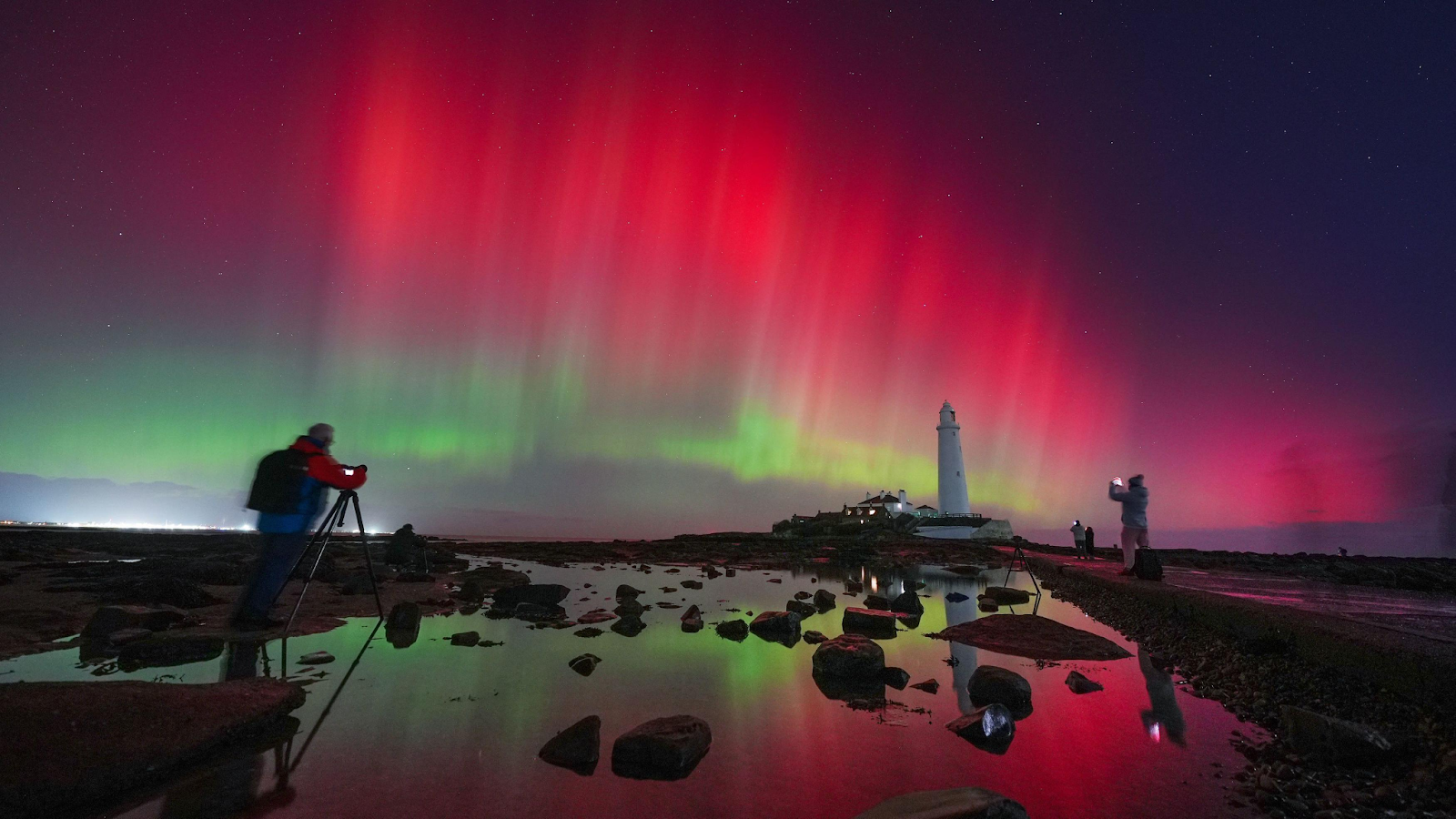
Last week, one of the most powerful solar events in recent years pushed the Northern Lights far beyond their usual Arctic home. From Texas and Alabama to California deserts and Arizona skies, Americans witnessed auroras in places once considered impossible. Here’s where the aurora appeared, why it happened, and what it means for future skywatchers.
A Sky That Rewrote the Rules
For generations, Americans have grown up believing one simple truth about the Northern Lights: you have to go north to see them. Alaska. Northern Canada. Iceland. Norway. That’s where auroras live—or so we thought.
Last week changed everything.
Across the United States, people stepped outside expecting an ordinary night sky and instead found something almost surreal. Soft red glows hovered above treelines. Pink arcs shimmered across horizons. Cameras captured colors that eyes barely registered at first. Social media exploded with disbelief as Americans asked the same question:
“Is this really the aurora… here?”
The answer was yes.
An unusually powerful geomagnetic storm unleashed a rare chain reaction, stretching the auroral oval deep into parts of the U.S. that had never—or almost never—seen it before. This wasn’t just a good aurora night. It was a once-in-a-generation sky event.
And some of the locations where it appeared will absolutely shock you.
Why Was the Aurora Visible So Far South Last Week?
To understand what happened, we need to look 93 million miles away—at the Sun.
In the days leading up to the event, the Sun released a series of powerful solar flares and coronal mass ejections (CMEs). These eruptions hurled massive clouds of charged particles toward Earth at incredible speed. When they collided with Earth’s magnetic field, they caused a severe geomagnetic storm.
According to space weather monitoring agencies like NASA and NOAA:
- The storm reached G4–G5 levels, classified as “severe”
- Earth’s magnetic field was temporarily distorted
- The auroral oval expanded thousands of miles southward
- High-altitude red auroras became visible at lower latitudes
Under normal conditions, auroras remain near the poles. But when geomagnetic storms intensify, Earth’s magnetic defenses bend and stretch—allowing auroras to spill into regions that almost never see them.
Last week, those conditions aligned perfectly.
What Made This Aurora Event So Rare?
Auroras are not rare by themselves. But auroras this far south absolutely are.
Several factors made last week exceptional:
- Multiple CMEs hit Earth back-to-back, amplifying the effect
- The Sun is nearing solar maximum, its most active phase
- Clear skies covered much of the U.S. during peak activity
- The storm lasted long enough for widespread visibility
This combination doesn’t happen often. When it does, it creates skywatching history.
1. Texas: The Aurora That No One Expected 🌌
Texas may be the last place most Americans would ever expect to see the Northern Lights—but last week, it happened.
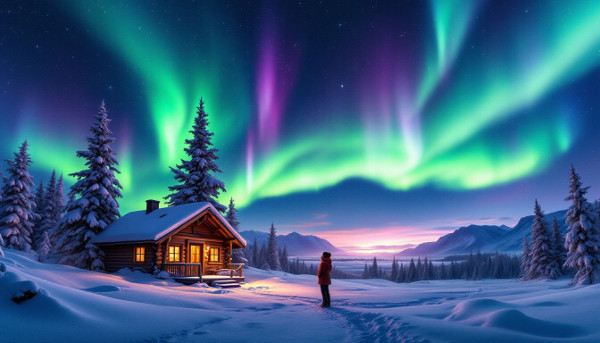
Residents across North and Central Texas reported strange, colorful glows shortly after sunset and into the late night hours. In areas outside Dallas, near Amarillo, and in rural stretches around Austin, people noticed faint pink and red hues hovering low in the northern sky.
At first, many dismissed it as light pollution or distant city glow. But as the lights subtly shifted and intensified, phones came out—and disbelief followed.
Real-Life Experience From Texas
One photographer near Lubbock described the moment as “watching the sky quietly breathe.” Another resident said they only realized it was an aurora after neighbors started sharing photos online.
Why Texas saw the aurora:
- Strong geomagnetic activity pushed auroras south
- Red auroras, which occur at higher altitudes, travel farther
- Texas’s flat horizons make faint glows easier to detect
For many Texans, it was the first—and possibly only—time they’ll ever see the aurora without leaving the state.
2. Alabama and Mississippi: The Deep South Lights Up
If Texas was surprising, Alabama and Mississippi were downright shocking.
Across northern Alabama and parts of Mississippi, residents reported faint but unmistakable auroral colors. Rural highways, farmland, and open fields provided dark skies that allowed subtle reds and purples to emerge.
In many cases, people didn’t realize what they had seen until they compared photos the next morning.
Why the Deep South Aurora Matters
Auroras this far south are extremely uncommon. The Deep South sits well outside traditional auroral visibility zones, making these sightings historically rare.
Key observations included:
- Pink and violet arcs near the horizon
- Slow, wave-like movement lasting several minutes
- Stronger visibility through smartphone night modes
For lifelong residents, it was an emotional experience—proof that nature still holds surprises no matter how familiar the landscape feels.
3. Northern California: Auroras Meet the Pacific 🌊
Northern California delivered some of the most visually stunning aurora photos of the event.
Skywatchers near Mount Shasta, Lassen Volcanic National Park, and remote coastal regions reported glowing skies that reflected off water, snow, and rugged terrain. The contrast between auroral colors and California’s natural landscapes created images that quickly went viral.
Why California’s Aurora Looked So Dramatic
Northern California benefited from ideal conditions:
- High elevations with clearer atmospheric visibility
- Low humidity in inland regions
- Minimal cloud cover during peak geomagnetic activity
In some locations, auroras appeared as faint red curtains, while in others, green and pink hues shimmered over mountain ridges.
For photographers, it was a dream scenario—one rarely repeated.
4. The Midwest: Familiar Territory, Unfamiliar Intensity
The Midwest is no stranger to auroras, especially in northern states like Michigan and Minnesota. But last week’s event pushed visibility much farther south and brighter than usual.
Residents in:
- Illinois
- Indiana
- Ohio
- Michigan
…reported vibrant auroral displays, even near suburban areas.
In Michigan’s Upper Peninsula, the lights danced overhead. Farther south, near Chicago’s outskirts, faint but colorful glows pierced through light pollution—something that rarely happens.
Why the Midwest Keeps Getting Aurora Action
The Midwest’s geography helps:
- Slightly higher latitude than southern states
- Expansive open land with fewer obstructions
- Frequent visibility during strong solar storms
But the intensity and reach of last week’s aurora made it one of the most memorable Midwest displays in years.
5. Arizona’s Desert Aurora: The Most Shocking Location 🌵✨
This was the moment that stunned even seasoned astronomers.
Arizona.
A state known for deserts, heat, and clear blue skies—not auroras.
Yet last week, residents in northern and central Arizona reported faint red and purple glows stretching across the night sky. Near Flagstaff and along dark desert highways, auroras appeared low on the horizon, blending surreal colors with cactus silhouettes.
Why Arizona’s Aurora Is Almost Unbelievable
Auroras over deserts are extraordinarily rare.
Arizona’s appearance on the aurora map was made possible by:
- Exceptionally strong geomagnetic disturbance
- High-altitude red auroras visible at extreme distances
- Crystal-clear desert skies with minimal humidity
For many observers, it felt like witnessing a cosmic glitch—a reminder that nature doesn’t always follow our expectations.
How Social Media Turned the Aurora Into a National Event
Unlike past aurora events, this one didn’t rely on news outlets to spread awareness.
Americans learned about it from:
- Neighbors posting photos
- TikTok videos going viral overnight
- Reddit threads filling with side-by-side comparisons
- Instagram stories tagged with disbelief
Common reactions included:
- “I thought my camera was broken”
- “I’ve lived here 40 years and never seen this”
- “I didn’t even know this was possible”
This grassroots sharing turned a scientific event into a shared cultural moment.
What Scientists Say About the Future of Low-Latitude Auroras
Experts emphasize that auroras appearing this far south doesn’t mean they’ll become routine—but it does signal an active period.
Key scientific insights:
- The Sun is approaching solar maximum (2025–2026)
- Solar storms are becoming more frequent and intense
- Low-latitude auroras may appear more often during peaks
According to NASA, solar cycles naturally fluctuate, and we’re currently nearing the most energetic phase. That increases the chances—but doesn’t guarantee—future surprises.
How to Spot the Aurora Next Time (Practical Tips)
If last week taught Americans anything, it’s this: be ready.
Here’s how to improve your chances:
- Monitor NOAA’s aurora forecast and Kp index
- Look north from dark, rural locations
- Avoid city lights when possible
- Use smartphone night mode or long-exposure photography
- Be patient—auroras often come in waves
Even faint glows invisible to the naked eye can appear vividly in photos.
Why Auroras Matter Beyond Their Beauty
Auroras are more than sky art—they’re visible proof of Earth’s relationship with the Sun.
Severe geomagnetic storms can also affect:
- GPS navigation accuracy
- Satellite communications
- Power grid stability (in extreme cases)
While last week’s storm caused minimal disruption, it served as a reminder of how deeply space weather influences modern life.
Frequently Asked Questions (Trending U.S. Searches)
1. How far south were the Northern Lights visible last week?
Auroras were confirmed as far south as Texas, Alabama, Mississippi, and Arizona.
2. Did the aurora really appear in Texas?
Yes. Verified photos and eyewitness reports confirm auroral visibility in multiple Texas locations.
3. Why were many auroras red instead of green?
Red auroras occur at higher altitudes and are more visible at lower latitudes during strong storms.
4. Are auroras dangerous?
No. Auroras themselves are harmless and pose no risk to people on the ground.
5. Is this a sign of climate change?
No. Auroras are driven by solar activity, not Earth’s climate systems.
6. Will auroras keep appearing in the southern U.S.?
They may occur occasionally during strong solar storms, especially near solar maximum.
7. Can auroras damage electronics?
Indirectly. Severe storms can affect satellites and power systems, but auroras are just the visible effect.
8. Do I need special equipment to see auroras?
No, but cameras often capture colors better than human eyes.
9. When is the next likely aurora event?
Solar activity remains high through 2026, increasing the chances of future events.
10. Where should I check for aurora alerts?
NOAA’s Space Weather Prediction Center and NASA’s solar updates are the most reliable sources.
Final Thoughts: A Night America Won’t Forget
Last week’s aurora wasn’t just rare—it was transformative.
It reminded millions of Americans that the universe is dynamic, unpredictable, and deeply connected to our daily lives. From Texas plains to Arizona deserts, people looked up and realized the sky still has the power to surprise us.
And for those who witnessed it, the memory will glow forever.