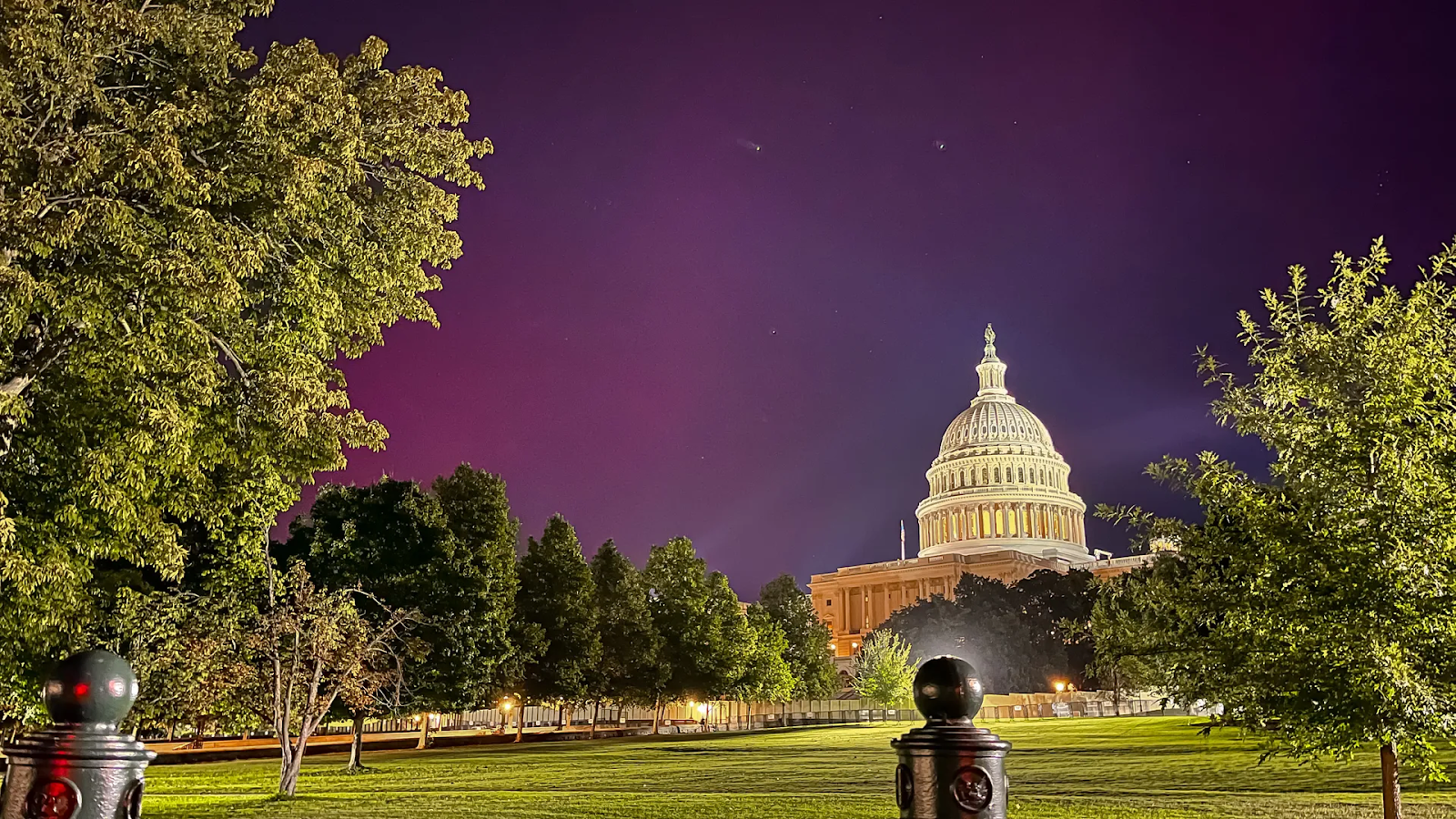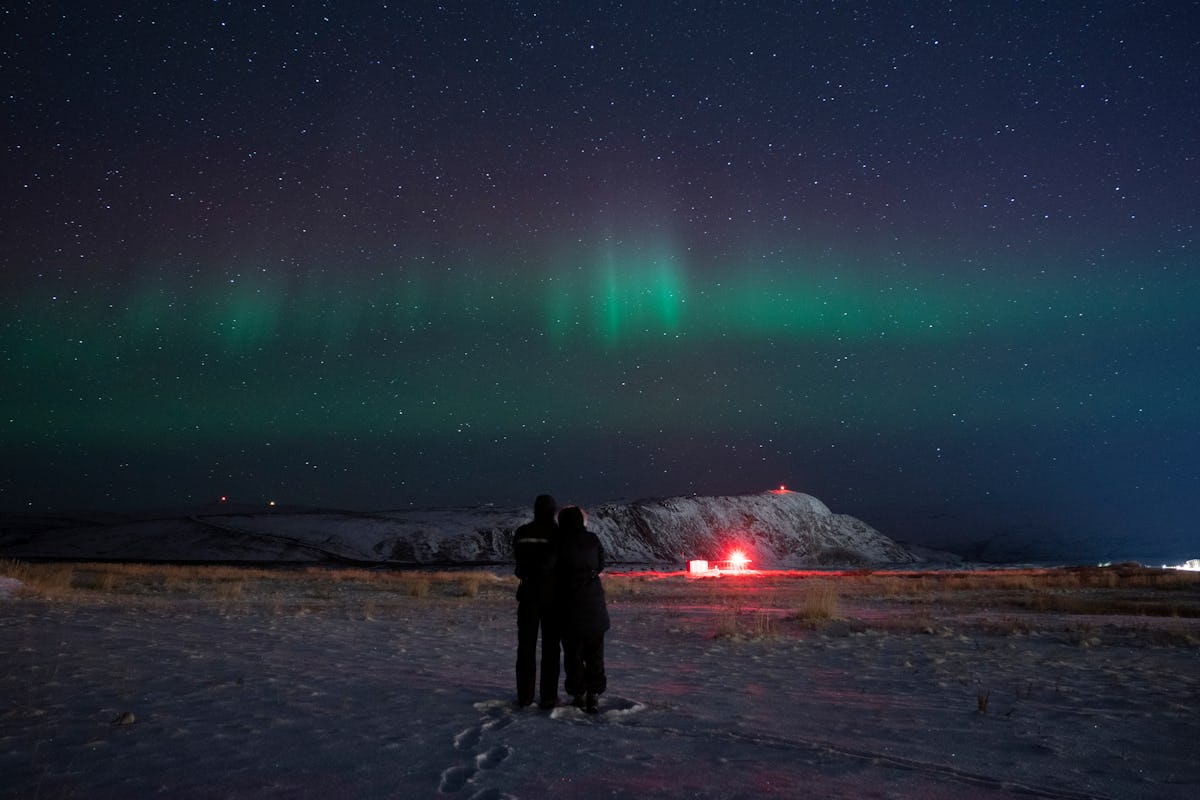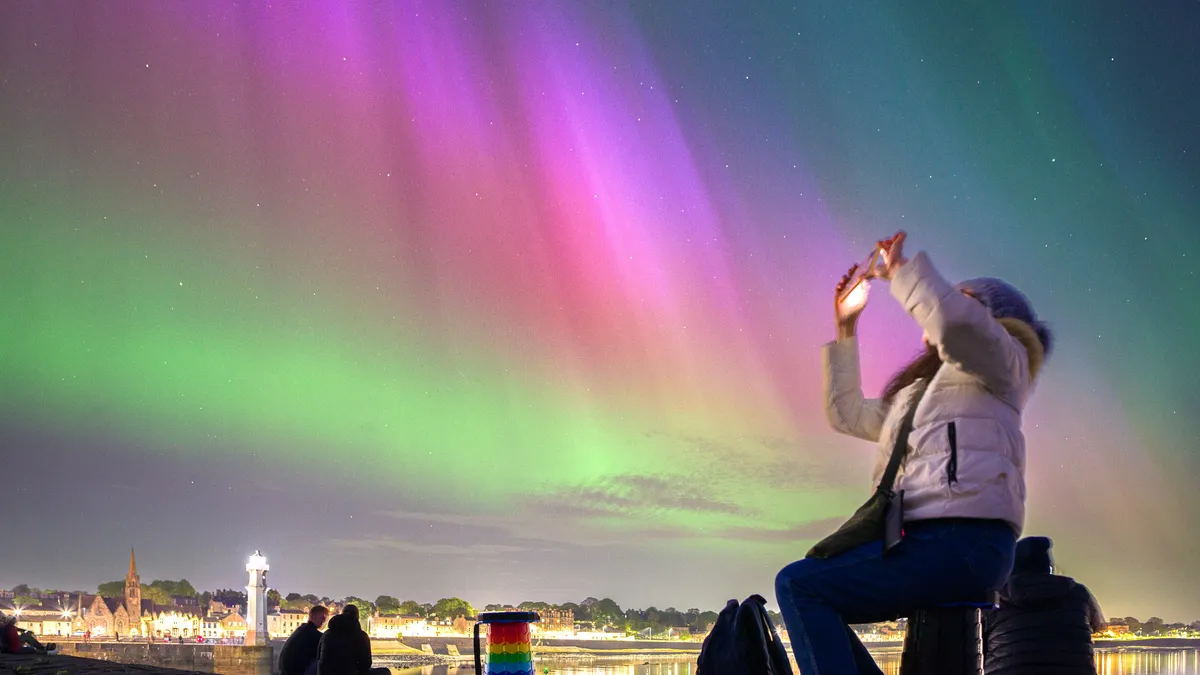
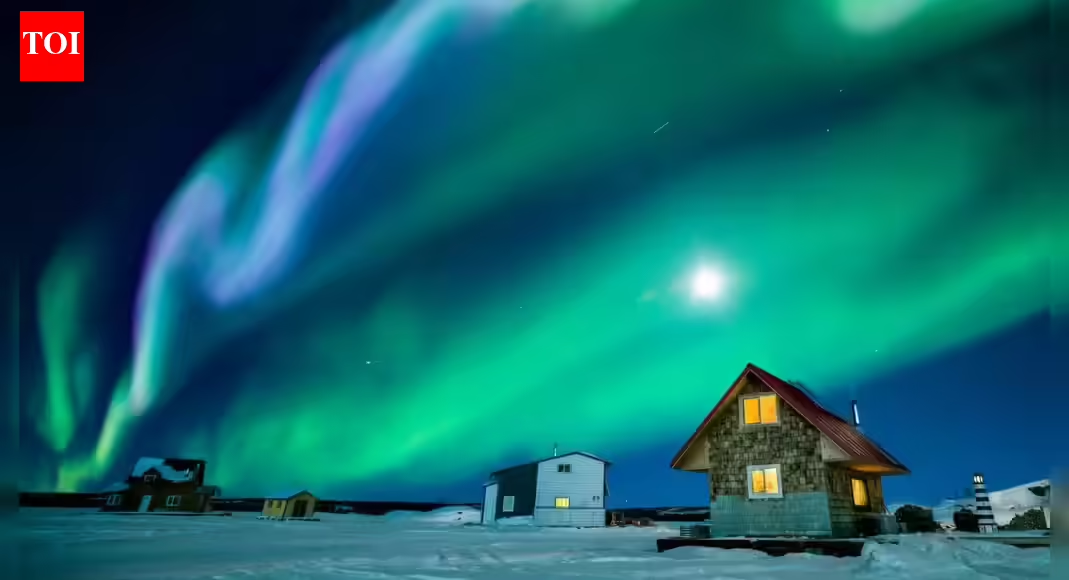
Viral photos showing auroras glowing over unexpected U.S. cities have stunned Americans and scientists alike. Triggered by a powerful geomagnetic storm during peak solar activity, the Northern Lights reached far beyond their usual polar zones. From Texas to Ohio, these rare sightings reveal how intense solar storms can reshape the night sky—and why more surprises may be coming.
When the American Night Sky Suddenly Looked Unreal
For many Americans, the moment began with disbelief.
People scrolling through social media late at night stopped in their tracks. Familiar skylines—suburban neighborhoods, farmland, highways, and city rooftops—were suddenly framed by skies glowing red, pink, green, and purple. The captions were often the same: “Is this real?” or “Can someone explain what I’m seeing?”
Within hours, scientists confirmed what few expected to hear: the aurora borealis was visible over unexpected U.S. cities, far south of where it normally appears.
These weren’t isolated sightings or digital tricks. They were the visible result of a powerful solar-driven geomagnetic storm—one strong enough to stretch Earth’s magnetic field and turn millions of ordinary Americans into witnesses of a rare cosmic event.
Why These Aurora Photos Shocked the Internet
Auroras themselves are not rare on Earth. What shocked people was where they appeared.
The Northern Lights are typically associated with:
- Alaska
- Northern Canada
- Iceland
- Scandinavia
Seeing them above states like Texas, Alabama, Missouri, or Ohio defies what most people believe is possible.
What made these photos particularly shocking:
- Auroras were seen across multiple U.S. regions at once
- Southern states reported confirmed sightings
- City light pollution didn’t completely wash them out
- Smartphones captured vivid colors with ease
According to NOAA’s Space Weather Prediction Center, this event was driven by a severe geomagnetic storm, classified among the strongest categories scientists track.
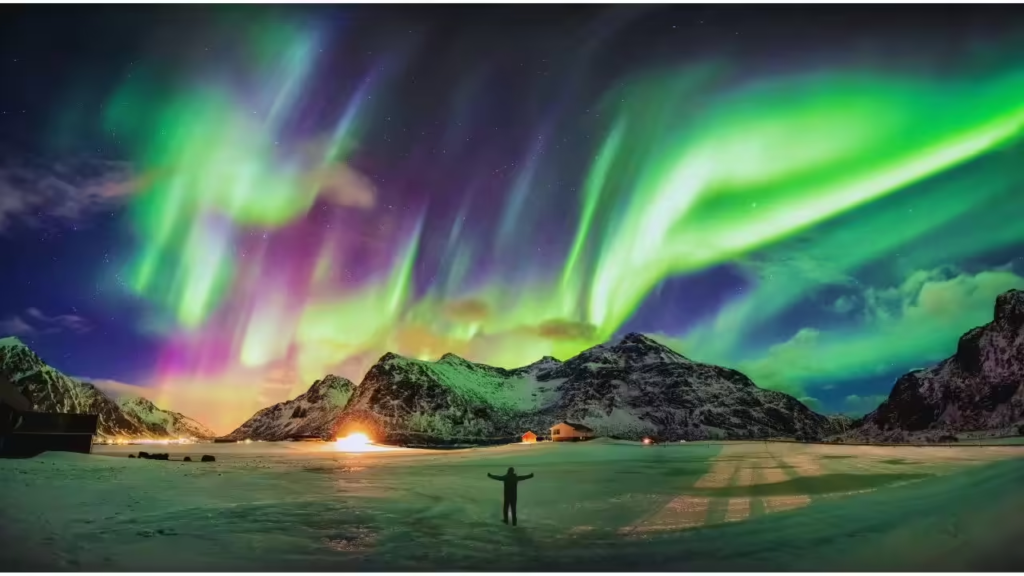
What Is an Aurora, Really? A Simple Explanation
Auroras occur when charged particles from the Sun collide with Earth’s upper atmosphere.
These particles travel along Earth’s magnetic field lines and strike gases high above the planet. When that happens, energy is released in the form of light.
Different gases create different colors:
- Oxygen produces green and red light
- Nitrogen produces blue and purple hues
Normally, Earth’s magnetic field funnels these particles toward the poles, which is why auroras usually stay far north or south.
But when the Sun becomes unusually active, that magnetic shield can weaken—allowing auroras to spread into unexpected regions.
The Solar Storm Behind the Stunning Images
The event was triggered by a massive coronal mass ejection (CME)—a giant cloud of magnetized plasma blasted from the Sun’s surface.
When this CME reached Earth:
- Billions of charged particles slammed into Earth’s magnetosphere
- The magnetic field compressed and stretched
- Energy flooded the upper atmosphere
- Auroral activity expanded dramatically
NOAA classified the storm as G4–G5, placing it among the strongest geomagnetic storms observed in recent decades.
Why Auroras Appeared Over Unexpected U.S. Cities
This is the question Americans are searching for most.
The answer lies in the strength of the geomagnetic disturbance.
During extreme solar storms:
- Earth’s magnetic field temporarily weakens
- The auroral oval expands toward the equator
- Lower-latitude states fall within aurora visibility zones
- Auroras appear higher in the atmosphere
That’s why cities far from the Arctic suddenly found themselves under glowing skies.
Real-Life Examples From Across the United States
Texas
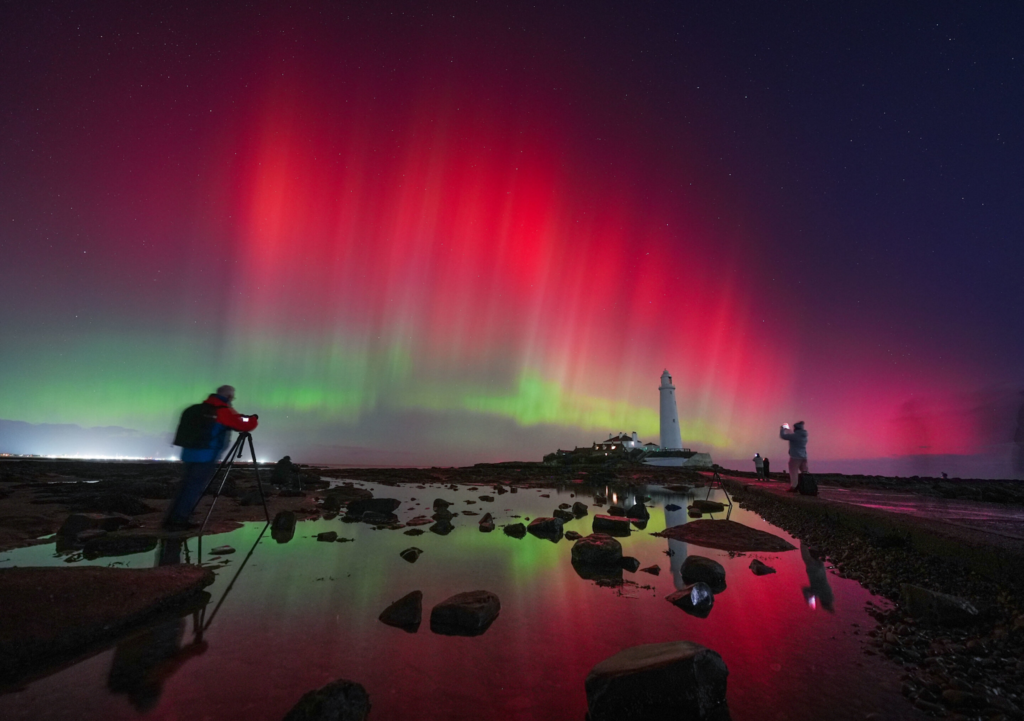
In North Texas, residents noticed red and pink glows hovering just above the horizon. Many initially assumed it was distant city light reflecting off clouds—until photos revealed smooth auroral arcs stretching across the sky.
Alabama
Rural areas outside Birmingham and Huntsville reported faint pink streaks visible to the naked eye. Long-exposure smartphone photos made the auroras unmistakable.
Midwest Cities
Ohio, Indiana, Missouri, and Illinois all reported aurora sightings. In some suburbs, green and red lights were visible even with moderate light pollution.
West Coast
Parts of northern California and Oregon experienced auroras shimmering above coastal cities, blending cosmic light with familiar urban silhouettes.
For many Americans, it was the first time they had ever seen the Northern Lights—without traveling anywhere.
Why Smartphones Made the Auroras Look Even Better
One reason these photos spread so quickly is simple: modern phone cameras are incredibly sensitive to low light.
Even when auroras appear faint to the naked eye, smartphones can:
- Capture more light than human vision
- Reveal colors invisible to the eye
- Enhance contrast using night mode
This explains why some people “didn’t see much” until they checked their photos—and suddenly realized what they had witnessed.
What the Aurora Colors Tell Scientists
Auroral colors provide clues about altitude and energy levels.
- Green auroras form when oxygen is hit at lower altitudes
- Red auroras occur higher in the atmosphere
- Purple and blue hues come from nitrogen
Southern auroras are often red because the solar particles interact higher above Earth, producing broad, diffuse glows instead of sharp curtains.
Were the Viral Aurora Photos Edited or Fake?
This question trended heavily after the images went viral.
Scientists confirmed that the vast majority of the images were authentic, though some used long exposure or enhanced contrast.
Important clarifications:
- Long exposure reveals auroras—it doesn’t create them
- Smartphone processing amplifies real light
- Independent satellite data confirmed auroral activity
When auroras are observed simultaneously across multiple states, scientists can verify them using ground sensors and space-based instruments.
Does This Mean Auroras Will Become Common in U.S. Cities?
Not common—but less rare than before.
The Sun is currently approaching solar maximum, the most active phase of its roughly 11-year cycle. During this period:
- Strong solar storms become more frequent
- Geomagnetic disturbances intensify
- Southern aurora sightings become more likely
Experts say Americans may see more events like this over the next one to two years, though each storm remains unpredictable.
Are Auroras Dangerous to People or Cities?
Auroras themselves are completely harmless to humans.
However, the solar storms that produce them can affect technology.
Potential Impacts Scientists Monitor
- GPS signal disruptions
- Radio communication interference
- Satellite malfunctions
- Aviation navigation issues
- Rare stress on power grids
During this event, agencies monitored infrastructure closely, and no widespread failures were reported.
Why Scientists Are Excited About These Photos
For researchers, these images are more than beautiful—they’re valuable data.
Millions of photos help scientists:
- Map auroral boundaries
- Measure storm intensity
- Improve space-weather models
- Better protect satellites and power grids
With everyday Americans unintentionally acting as citizen scientists, researchers now have more observational data than ever before.
How Americans Can Spot the Next Aurora Event
You don’t need special equipment—just awareness.
Practical Aurora-Watching Tips
- Follow NOAA space-weather alerts
- Avoid city lights if possible
- Look north after sunset
- Use night mode on your phone
- Check the sky multiple times
Auroras can appear suddenly and fade just as quickly.
Is Climate Change Responsible for These Auroras?
This is a common misconception.
Auroras are caused by solar activity, not Earth’s climate. Climate change does not influence solar flares or geomagnetic storms.
However:
- Light pollution reduces visibility
- Clear skies improve viewing
- Rural locations offer the best chance
The cause of this event was purely solar.
Why These Images Resonated So Deeply
Beyond science, these photos touched something emotional.
In a world dominated by constant news cycles and stress, seeing the sky glow in impossible colors reminded people that nature still holds surprises.
For many families, these aurora photos will become lifelong memories—moments when the universe briefly stepped into everyday life.
Key Takeaways
- A powerful solar storm triggered widespread U.S. auroras
- Unexpected cities experienced rare sightings
- Smartphones helped capture the event
- Auroras are safe but scientifically significant
- More events are possible during solar maximum
Frequently Asked Questions (10 Trending FAQs)
1. Were the aurora photos over U.S. cities real?
Yes, scientists confirmed widespread authentic sightings.
2. Why did auroras appear so far south?
A severe geomagnetic storm expanded the auroral zone.
3. What U.S. cities saw auroras?
Texas, Alabama, Ohio, Missouri, California, and many more.
4. Why were many auroras red instead of green?
Southern auroras form at higher altitudes, producing red hues.
5. Are auroras dangerous to people?
No, auroras are harmless.
6. Can solar storms damage power grids?
Rarely, but extreme storms can cause stress.
7. Will this happen again soon?
Yes, solar maximum increases the likelihood.
8. Can you see auroras without a camera?
Sometimes, but cameras often reveal more detail.
9. Is climate change linked to stronger auroras?
No, auroras are driven by solar activity.
10. Where can I track future aurora alerts?
NOAA’s Space Weather Prediction Center.