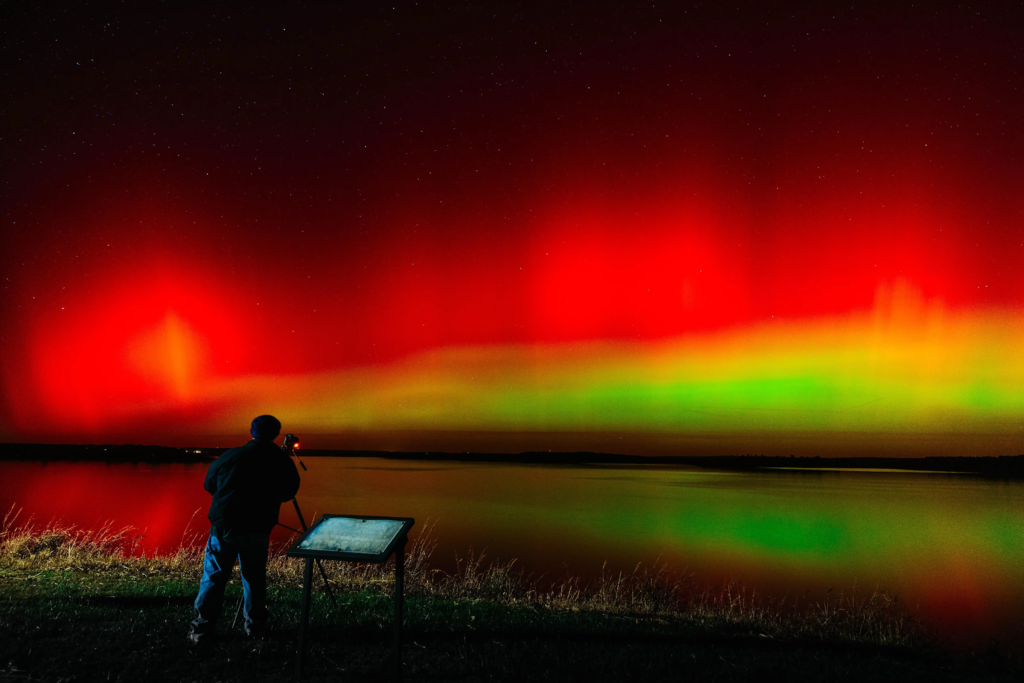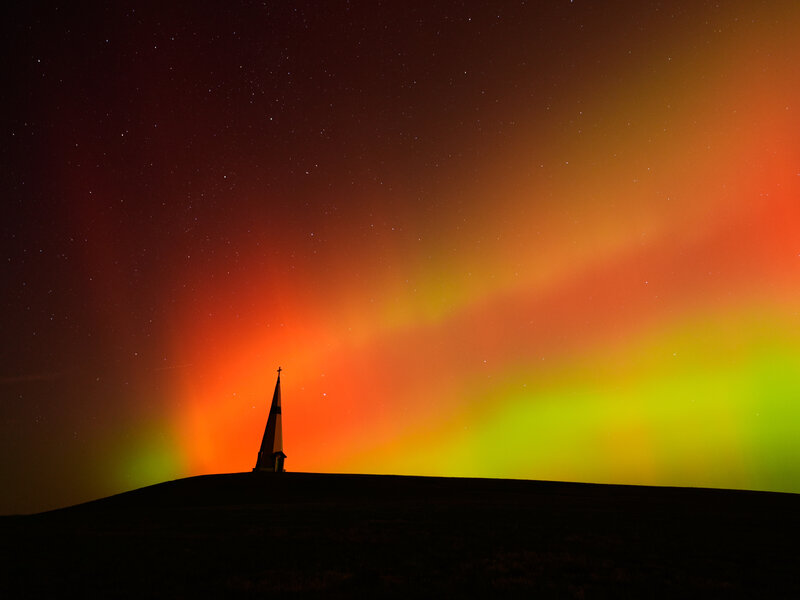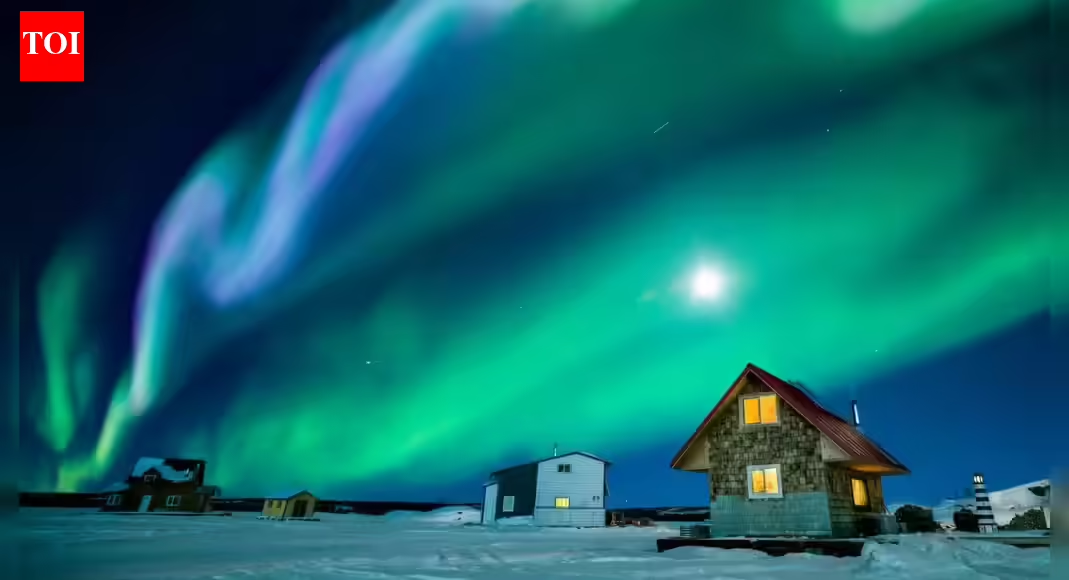
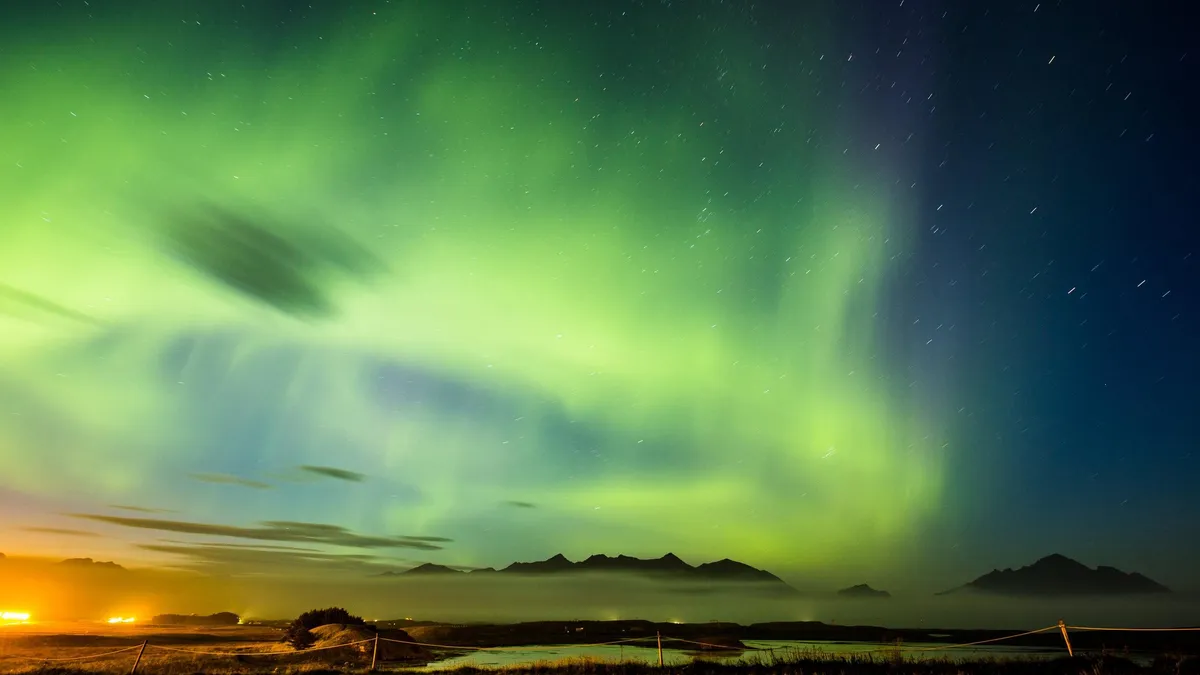
A rare Northern Lights alert has been issued as powerful solar activity could make auroras visible across 24 U.S. states tonight. Driven by intense geomagnetic storms and a highly active Sun, this event may bring glowing green, pink, and red skies far beyond typical northern regions. Experts say it could be one of the most widespread aurora displays Americans have witnessed in years.
Why This Northern Lights Alert Has Scientists and Americans Excited
For most Americans, the Northern Lights feel distant—something you travel thousands of miles to see. Alaska. Northern Canada. Iceland. Rarely, if ever, your own backyard.
Tonight, that expectation is being completely rewritten.
Space-weather forecasters are warning that a strong geomagnetic storm could push auroral activity deep into the continental United States, allowing 24 states to potentially witness cosmic colors lighting up the sky. This isn’t a routine alert. It’s the kind of space-weather event that captures the attention of scientists, photographers, weather experts, and everyday families alike.
The significance lies not only in the beauty of the aurora, but in how far south it may reach—into regions that almost never experience the phenomenon. For millions of Americans, this could be a once-in-a-decade opportunity to see the Northern Lights without leaving home.
What Exactly Triggered This Northern Lights Alert?
The source of tonight’s alert is the Sun—specifically, a surge of activity powerful enough to disrupt Earth’s magnetic environment.
Auroras occur when charged particles from the Sun collide with Earth’s magnetic field and atmosphere. These collisions excite gases such as oxygen and nitrogen, causing them to glow and form the shimmering lights known as the aurora borealis.
Under normal conditions, Earth’s magnetic field channels this activity toward the poles. But when solar activity intensifies, that protective magnetic shield can become overwhelmed.
This event was triggered by several key factors aligning at once:
- A coronal mass ejection (CME) erupted from the Sun
- Solar wind traveling at high speeds is headed directly toward Earth
- Increased particle density is compressing Earth’s magnetosphere
- Favorable magnetic alignment is allowing auroras to expand southward
When all of these conditions come together, the auroral oval expands—sometimes dramatically—bringing the Northern Lights into places they’re rarely seen.
Which 24 U.S. States Could See the Northern Lights Tonight?
Visibility depends on weather, light pollution, and timing, but forecasts suggest auroras could be visible across a large portion of the country.
States with the highest likelihood of seeing auroras:
- Alaska
- Minnesota
- North Dakota
- South Dakota
- Montana
- Michigan
- Wisconsin
- Maine
- Vermont
- New Hampshire
- New York
States where auroras may be visible under ideal conditions:
- Pennsylvania
- Ohio
- Illinois
- Indiana
- Iowa
- Nebraska
- Missouri
- Kentucky
- Virginia
- North Carolina
- Washington
- Oregon
- Idaho
During similar geomagnetic storms in the past, faint auroras were also captured farther south using smartphone cameras—sometimes before people realized what they were seeing.
When Is the Best Time to See the Northern Lights Tonight?
Timing is critical when it comes to aurora viewing.
In most cases, auroras peak between 10:00 PM and 2:00 AM local time, when Earth’s magnetic field is best positioned to interact with incoming solar particles. However, strong geomagnetic storms don’t always follow the rules.
A real-world example
During the powerful aurora storm of March 2015, residents in Wisconsin reported seeing auroras shortly after sunset, while others in Michigan and New York saw activity continue well past 3:00 AM.
Tonight’s storm has the potential to behave similarly, with bursts of activity appearing earlier or lasting longer than expected.
How Bright Could the Northern Lights Be?
Aurora strength is measured using the Kp index, which ranges from 0 (quiet) to 9 (extreme).
- Kp 5–6: Typical auroras visible in northern U.S. states
- Kp 7: Strong auroras with noticeable motion and color
- Kp 8–9: Rare, historic events with far-southern visibility
Forecast models suggest tonight’s event could reach Kp 7 or higher, placing it among the strongest aurora alerts of the past decade. At these levels, auroras often move rapidly, brighten suddenly, and display multiple colors.
What Will the Northern Lights Look Like From the U.S.?
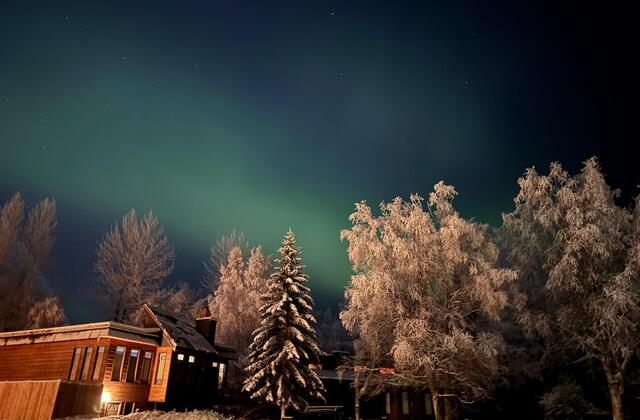
Many Americans expect auroras to resemble dramatic photos from Iceland or Norway. While that can happen, southern auroras often look more subtle—but still breathtaking.
Common appearances include:
- A soft green or white glow near the northern horizon
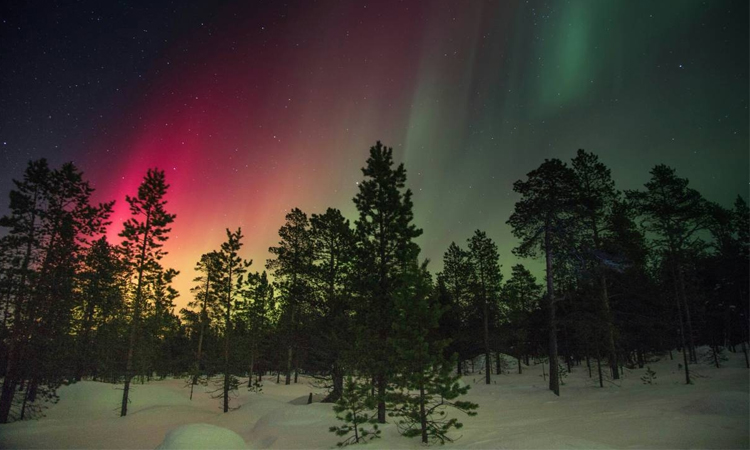
- Pink or red hues during stronger bursts
- Slow rippling or pulsing motion
- Colors appearing brighter and clearer in photos
It’s common for first-time viewers to mistake auroras for thin clouds or distant city lights—until the glow begins to move.
Why Your Phone Camera May See the Aurora Before You Do
One of the most surprising aspects of recent aurora events is how often people only realize what they’ve seen after checking their phone.
Modern smartphone cameras are highly sensitive to low light. They capture light over longer exposures than the human eye, allowing them to reveal faint colors and details.
Cameras often detect:
- Subtle green arcs invisible to the naked eye
- Red and pink hues at higher altitudes
- Rapid changes in auroral structure
This has turned millions of Americans into accidental aurora photographers during recent storms.
Real Stories: Americans Experiencing the Northern Lights for the First Time
During recent Northern Lights alerts, social media filled with disbelief and wonder.
In Ohio, a couple stepping outside noticed the sky looked unusually bright. A quick photo revealed faint green streaks above the treeline. In Missouri, a parent woke their children after realizing the glow wasn’t clouds. In Pennsylvania, neighbors gathered silently as soft red tones appeared overhead.
These moments matter because they transform a scientific phenomenon into a shared human experience—one that people remember for the rest of their lives.
Is This Connected to the Sun’s Solar Cycle?
Yes—and that’s a big reason aurora alerts are becoming more frequent.
The Sun follows an 11-year solar cycle, alternating between quiet and active phases. Scientists expect the current cycle, Solar Cycle 25, to peak around 2025–2026.
As solar maximum approaches, the Sun produces:
- More sunspots
- More solar flares
- More coronal mass ejections
- More geomagnetic storms affecting Earth
Experts have warned that this phase could bring the most frequent southern aurora events in decades. Tonight’s alert may be part of a broader trend rather than a one-off event.
Can the Northern Lights Affect Technology or Daily Life?
Strong geomagnetic storms don’t just create beautiful skies—they interact with modern systems.
Possible effects include:
- Temporary GPS inaccuracies
- Minor satellite communication disruptions
- Radio signal interference
- Airline route adjustments near polar regions
According to space-weather agencies, no major power grid disruptions are expected from this event, and infrastructure operators are monitoring conditions closely.
How to Maximize Your Chances of Seeing the Northern Lights Tonight
Auroras are unpredictable, but preparation helps.
Practical tips for viewers:
- Find a dark location with a clear northern view
- Turn off nearby lights
- Let your eyes adjust for at least 10 minutes
- Use your phone camera or night mode
- Stay outside for 20–30 minutes
Auroras often come in waves—patience is essential.
Why This Northern Lights Alert Feels So Emotional
Auroras often trigger deep emotional responses, especially among first-time viewers.
Psychologists suggest this is because auroras combine:
- Rarity
- Natural beauty
- A sense of cosmic scale
- Shared human experience
During past aurora events, people described feelings of awe, calm, and connection. Families gathered outside. Strangers spoke to one another. For a brief moment, everyone looked up.
Tonight has the potential to create those moments again—across much of the United States.
How Tonight Compares to Historic Aurora Events
2013 St. Patrick’s Day Storm
Auroras were visible across the Midwest and Northeast, sparking massive public interest.
2003 Halloween Storms
Auroras reached deep into the southern U.S., with significant geomagnetic effects worldwide.
While tonight’s event may not surpass 2003 in raw intensity, it could rival or exceed 2013 in geographic reach and public participation, thanks to smartphones and social media.
What If You Miss the Northern Lights Tonight?
Solar activity remains elevated.
If you miss tonight’s display:
- More geomagnetic storms are likely
- Aurora alerts may increase through 2026
- Another opportunity could arrive sooner than expected
This may not be the last cosmic surprise of the year.
Final Takeaway: Why Tonight Truly Matters
A Northern Lights alert covering 24 U.S. states is rare. It’s a reminder that Earth exists in a dynamic relationship with the Sun—and that extraordinary beauty can appear anywhere.
If skies are clear where you live, step outside. Look north. Take a photo.
You may witness something unforgettable.
Frequently Asked Questions (Trending Searches)
1. Can you really see the Northern Lights in 24 U.S. states tonight?
Yes, forecasts suggest auroras may be visible across 24 states under the right conditions.
2. What time are the Northern Lights most visible?
Usually between 10 PM and 2 AM local time.
3. Do I need special equipment to see the aurora?
No. The naked eye works, though cameras help.
4. What colors might I see?
Green is most common, with possible pink or red during strong activity.
5. Will clouds block aurora visibility?
Yes. Clear skies are essential.
6. Are the Northern Lights dangerous?
No. They are completely safe to watch.
7. Why do auroras look better on phones?
Cameras capture light over longer exposures.
8. Is this related to solar flares?
Yes. Solar flares and CMEs trigger geomagnetic storms.
9. Will auroras become more common?
Yes. Solar activity is increasing toward solar maximum.
10. What if I miss this aurora event?
More aurora alerts are expected in the coming months.