
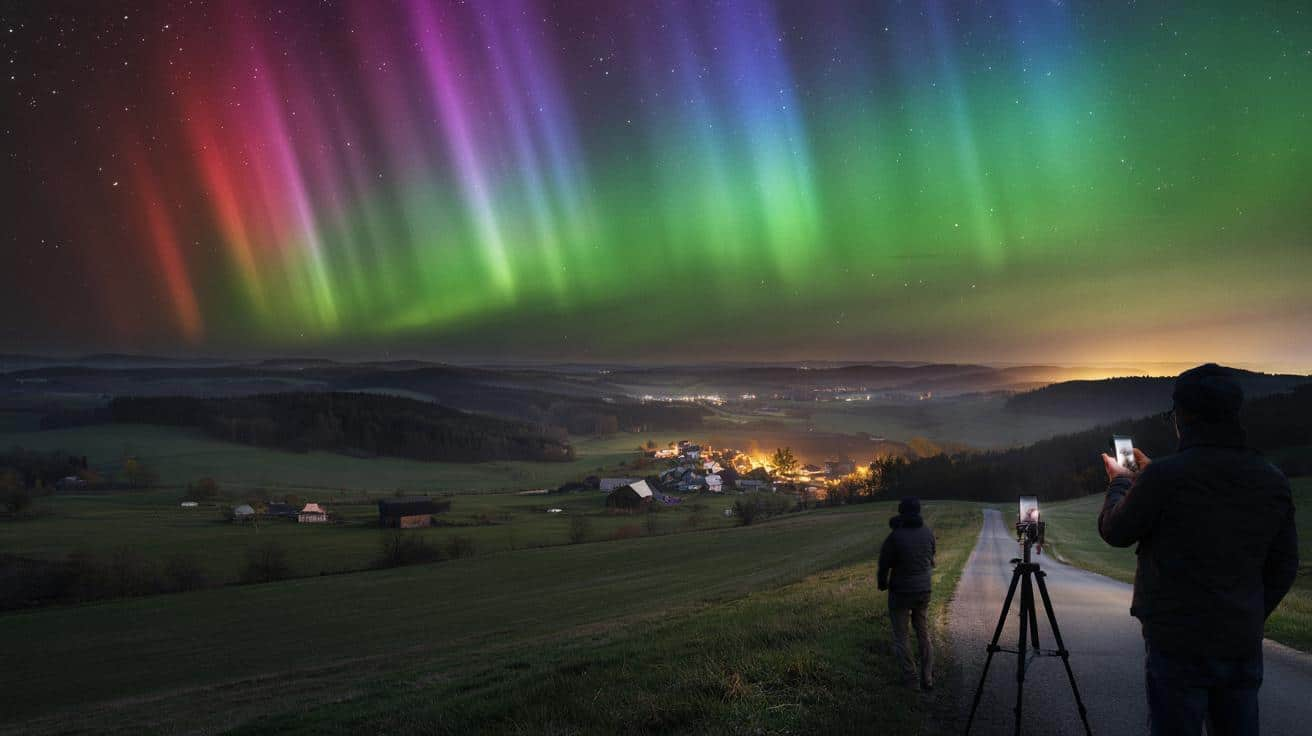
Aurora alerts promise the chance to see the Northern Lights—but many people misunderstand what they actually mean. This in-depth guide explains how aurora alerts work, why the sky turns green, and how scientists predict these events. Using real-life examples and practical advice, you’ll learn how to read alerts correctly, avoid common mistakes, and dramatically increase your chances of seeing the aurora yourself.
Why Are Aurora Alerts Suddenly Everywhere?
A decade ago, aurora alerts were mostly used by astronomers and serious night-sky enthusiasts. Today, they appear on weather apps, social media feeds, news sites, and even text notifications.
Americans who never imagined seeing the Northern Lights are now asking questions like:
- “Why did my phone say auroras were possible tonight?”
- “Is this alert real, or just clickbait?”
- “Why didn’t I see anything even though I got notified?”
The surge in aurora alerts isn’t accidental. It’s happening because solar activity is increasing, and auroras are becoming visible farther south than many people expect. At the same time, smartphone apps and real-time space-weather data have made alerts accessible to everyone.
The problem is not the alerts themselves—it’s how people interpret them.
What Is an Aurora Alert—Really?
An aurora alert is not a promise that the sky will glow green above your house.
It is a scientific probability signal.
Aurora alerts are issued when space-weather conditions suggest that energy from the Sun may interact strongly with Earth’s magnetic field. When those interactions are strong enough, auroras become possible at lower latitudes.
Think of an aurora alert the same way you think of a storm forecast:
- A “chance of thunderstorms” doesn’t mean rain is guaranteed.
- An aurora alert doesn’t mean lights are guaranteed.
It simply means the odds are higher than usual.
Why the Northern Lights Turn the Sky Green
Understanding alerts starts with understanding the green glow itself.
The Northern Lights—scientifically called aurora borealis—occur when charged particles from the Sun collide with gases in Earth’s upper atmosphere. These particles are guided by Earth’s magnetic field toward the poles, where they interact with oxygen and nitrogen atoms.
When oxygen atoms are excited at lower altitudes, they emit green light, which is why green is the most common aurora color.
Aurora alerts exist because scientists can measure when the invisible ingredients for this process are coming together—even before anything is visible in the sky.
The Science Behind Aurora Alerts (Without Overwhelming Jargon)
Aurora forecasting relies on three main components:
- Solar activity – what the Sun is releasing
- Solar wind conditions – how fast and dense the charged particles are
- Earth’s magnetic response – how strongly Earth reacts
Satellites such as DSCOVR, positioned between Earth and the Sun, measure solar wind in real time. These measurements feed into models run by agencies like NOAA’s Space Weather Prediction Center (SWPC).
If conditions look favorable, alerts are issued.
What makes this difficult is that space weather is chaotic. Small changes in magnetic orientation can completely change the outcome.
The Kp Index: The Number Everyone Talks About (and Misunderstands)
If you’ve ever checked an aurora forecast, you’ve probably seen the Kp index.
The Kp index measures how disturbed Earth’s magnetic field is on a scale from 0 to 9.
Here’s what those numbers realistically mean for most Americans:
- Kp 0–2 → Quiet conditions; no auroras outside polar regions
- Kp 3–4 → Minor activity; auroras stay far north
- Kp 5 → Northern U.S. states may see faint auroras near the horizon
- Kp 6–7 → Strong storms; auroras visible across much of the northern Midwest
- Kp 8–9 → Rare, extreme events; auroras can reach deep into the Lower 48
One of the biggest misconceptions is assuming Kp 5 equals a guaranteed show. In reality, Kp 5 simply means the possibility exists.
Real-Life Example: Why the Same Alert Works for One Person but Not Another
Imagine two people receiving the same aurora alert.
Person A stays in a city surrounded by streetlights, checks the sky for five minutes, sees nothing, and goes inside disappointed.
Person B drives 20 minutes to a dark rural road, turns off their headlights, waits patiently, and notices faint green arcs slowly drifting across the northern horizon.
Same alert. Completely different experiences.
Aurora alerts don’t replace dark skies, good timing, and patience. They only tell you when those factors might be rewarded.
Why Aurora Alerts Sometimes Feel “Wrong”
One of the most common complaints is:
“I got an aurora alert, but nothing happened.”
This doesn’t mean the alert was false.
Auroras require several conditions to align at once:
- Solar energy must arrive
- Earth’s magnetic field must align favorably
- Skies must be clear
- The Moon must not be too bright
- You must be in a dark location
Aurora alerts cannot account for local clouds, light pollution, or whether you stayed outside long enough. Those variables are up to you.
Which Aurora Alerts Are Most Reliable?
Not all alerts are created equal.
Experienced aurora watchers rarely rely on a single notification. Instead, they look for confirmation across multiple data sources.
The most reliable alerts usually combine:
- NOAA aurora forecasts
- Real-time solar wind data
- Rising (not falling) Kp index trends
- Ground-based magnetometer readings
When several indicators line up, confidence increases significantly.
Why Timing Matters More Than Most People Realize
Aurora alerts become far more accurate 30–60 minutes before an event.
That’s because satellites measure the actual solar wind just before it reaches Earth. Once scientists know the magnetic orientation of incoming particles, predictions sharpen dramatically.
This is why experienced skywatchers check alerts repeatedly throughout the night instead of relying on a single push notification.
When Is the Best Time to Look After an Alert?
Auroras don’t appear randomly throughout the night.
For most of the United States, the most reliable viewing window is:
- 10:00 PM to 2:00 AM local time
This doesn’t mean auroras can’t appear earlier or later—but statistically, this window offers the best odds.
Many people miss auroras simply because they looked too early, didn’t see anything immediately, and gave up.
Why the Aurora Isn’t Always Bright Green
Another common misunderstanding is expecting vivid neon green skies.
In reality:
- Auroras often start as gray or whitish glows
- Human eyes struggle with color in low light
- Movement is often easier to see than color
Many first-time viewers don’t realize they’re seeing an aurora until it begins to ripple or shift.
Why Phone Cameras “See” Auroras Better Than Your Eyes
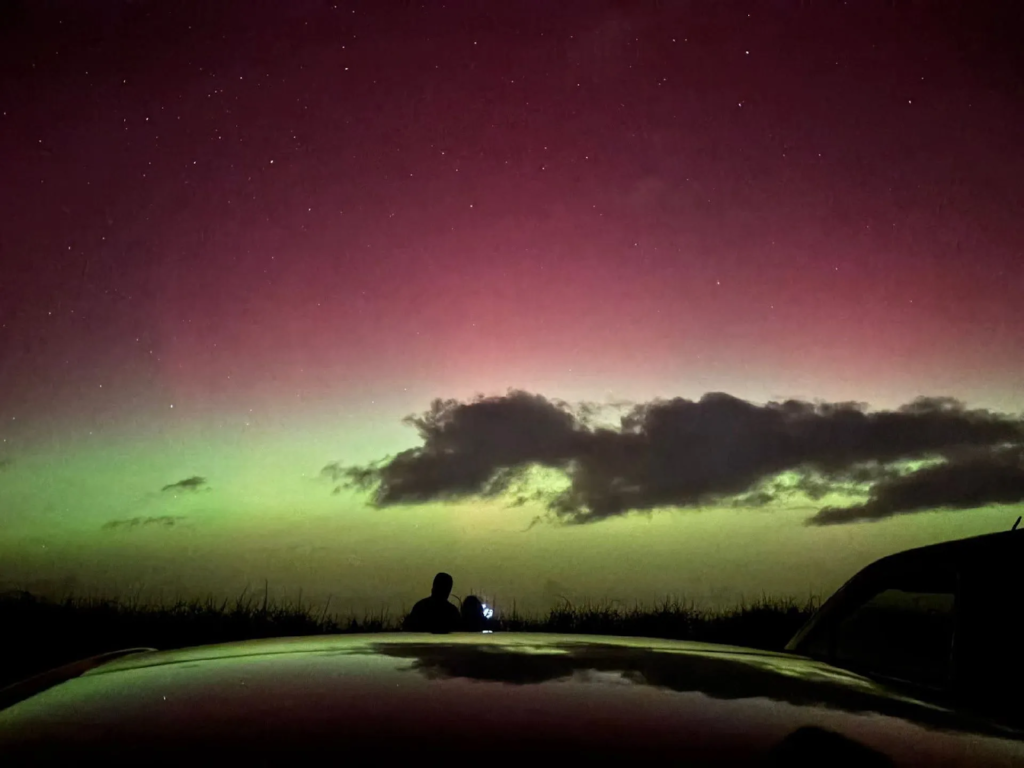
Smartphones often reveal auroras more clearly than the naked eye.
This happens because:
- Cameras collect light over time
- Sensors amplify faint colors
- Night modes exaggerate brightness
This doesn’t mean the aurora isn’t real—it means your eyes and brain are optimized for daylight, not faint nighttime color.
How Americans Successfully Use Aurora Alerts
People who consistently see auroras tend to follow similar habits:
- They track trends instead of single alerts
- They know nearby dark-sky locations
- They check weather forecasts alongside space weather
- They accept that some nights won’t work out
Over time, they develop intuition—something no app can fully replace.
Why Solar Maximum Is Making Alerts More Common
The Sun follows an 11-year solar cycle, and we are approaching solar maximum, expected around 2025–2026.
According to NASA:
- Solar flares increase during solar maximum
- Geomagnetic storms become more frequent
- Auroras appear farther south more often
This means aurora alerts are becoming more common—but also more misunderstood. More alerts don’t mean every night will deliver a show.
Common Mistakes That Lead to Missed Auroras
Most missed auroras happen for predictable reasons.
Avoid these mistakes:
- Ignoring cloud cover
- Staying near city lights
- Looking only for bright green color
- Leaving after just a few minutes
- Forgetting about moon brightness
Aurora alerts work best when paired with realistic expectations.
Step-by-Step: How to Use Aurora Alerts Correctly
When you get an alert:
- Check local cloud cover immediately
- Look at whether the Kp index is rising
- Drive away from city lights if possible
- Face north with an open horizon
- Let your eyes adjust for at least 20 minutes
- Stay outside for 30 minutes or longer
Auroras often arrive in waves rather than all at once.
Can You Predict Auroras Without Alerts?
Yes—but alerts make it much easier.
Before apps existed, aurora watchers relied on:
- Solar news
- Magnetometer disturbances
- Local experience and intuition
Alerts simply put that information into everyone’s pocket.
Why Aurora Alerts Are Probabilities, Not Promises
This is the most important concept to understand.
Aurora alerts answer only one question:
“Are conditions favorable right now?”
They do not answer:
- Will I definitely see it?
- Will it be bright?
- Will it last long?
Once you accept that, aurora alerts become exciting instead of frustrating.
Frequently Asked Questions (Trending U.S. Searches)
1. What exactly is an aurora alert?
A scientific notification that conditions may allow auroras to appear.
2. Do aurora alerts guarantee Northern Lights?
No. They indicate increased probability, not certainty.
3. What does Kp 5 or 6 really mean?
It means auroras are possible in northern U.S. states.
4. Why didn’t I see anything after an alert?
Clouds, light pollution, timing, or magnetic orientation may have interfered.
5. What time should I look for auroras?
Between 10 PM and 2 AM local time.
6. Why do auroras sometimes look white or gray?
Human eyes struggle with color perception in low light.
7. Are aurora alerts accurate?
They are scientifically sound but probabilistic.
8. Can auroras appear suddenly?
Yes. Activity can intensify within minutes.
9. Is solar maximum affecting alerts?
Yes. Increased solar activity leads to more frequent alerts.
10. Is it safe to watch auroras?
Yes. Auroras are completely harmless.
Final Thoughts: Turning Alerts Into Real Aurora Experiences
Aurora alerts aren’t magic—but they are powerful tools.
When you understand what they mean, how to read them, and what they don’t promise, they stop being frustrating and start being exciting.
The sky doesn’t turn green on command.
But when science, patience, and timing align, aurora alerts can help you be in the right place at the right moment—looking up instead of wondering what you missed.