A recent scientific study confirms that Mars experiences auroras, but they look nothing like Earth’s Northern Lights. Instead of colorful polar curtains, Martian auroras appear as faint ultraviolet glows scattered across the planet, driven by solar storms and a weak magnetic field. Scientists say these unusual auroras provide critical clues about Mars’ lost atmosphere, radiation risks, and the planet’s long-term habitability.
When Scientists Discovered That Mars Lights Up Too
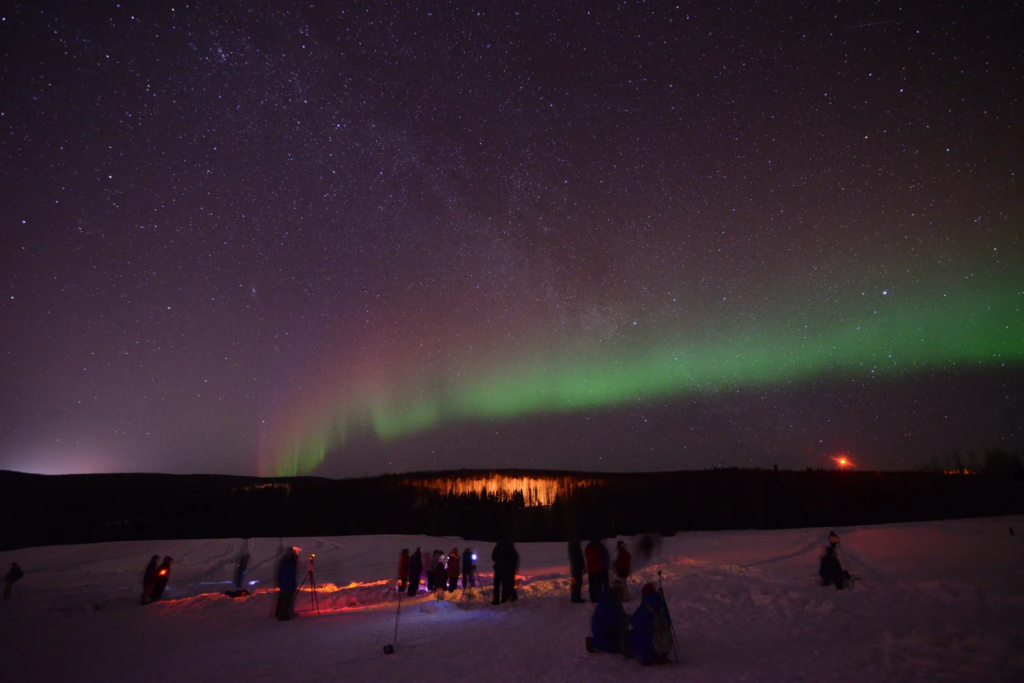
For generations, auroras were considered one of Earth’s most beautiful and unique natural phenomena. The Northern and Southern Lights became symbols of a planet protected by a powerful magnetic field, safely channeling solar energy into dazzling displays near the poles.
Mars, by contrast, was long seen as a silent, frozen desert—geologically fascinating, but atmospherically dead.
That perception changed dramatically when scientists studying Mars’ upper atmosphere noticed something unexpected: the Red Planet glows too.
Not in green curtains. Not in shimmering waves. But in subtle, ghostlike flashes of light that appear during solar storms. These emissions didn’t fit the traditional definition of auroras, and for years researchers debated what they were seeing.
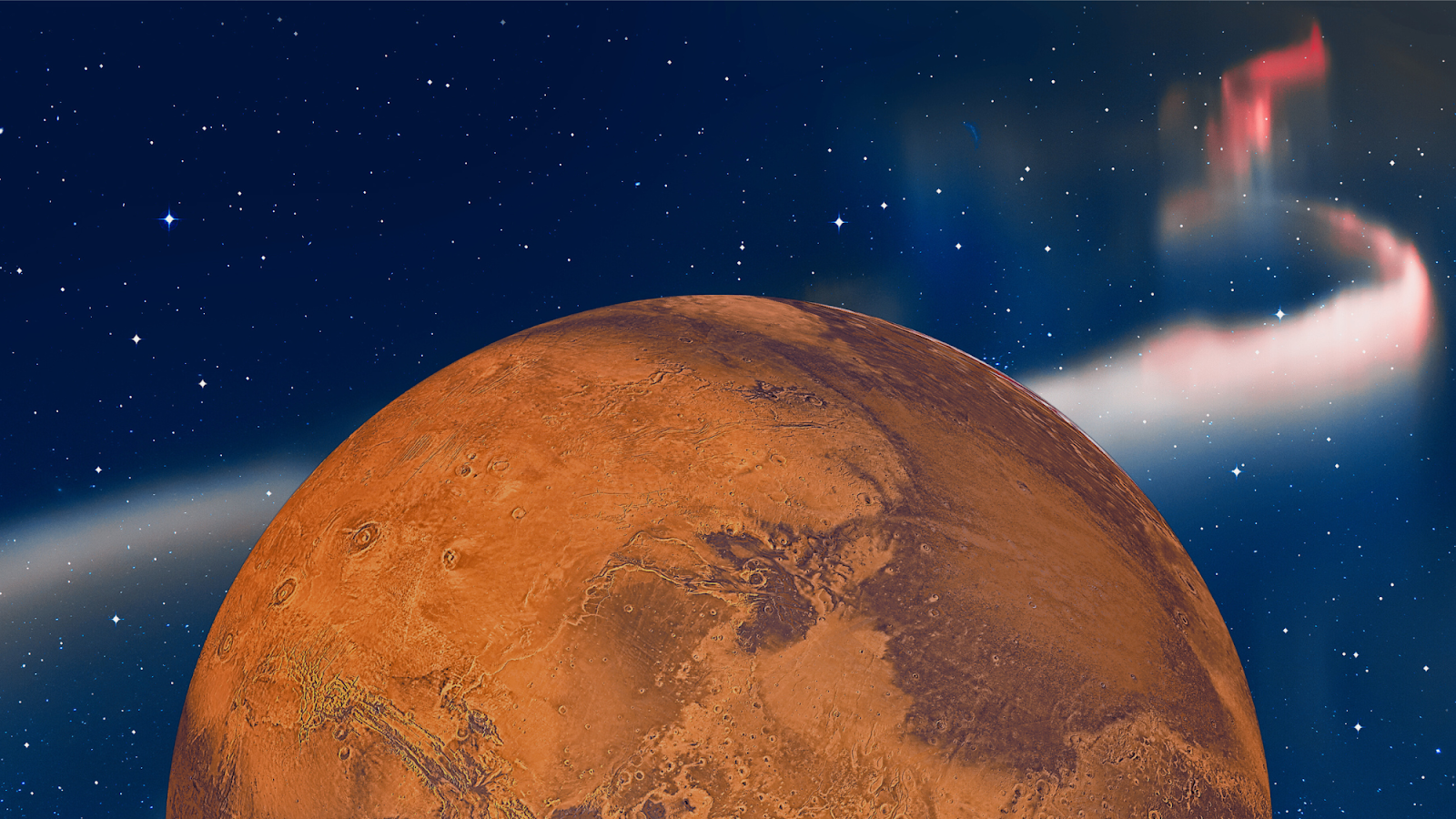
Now, a growing body of research has settled the question. Mars does have auroras—and they are unlike anything on Earth.
What Are Auroras And Why Mars Wasn’t Supposed To Have Them
A Familiar Earth Comparison
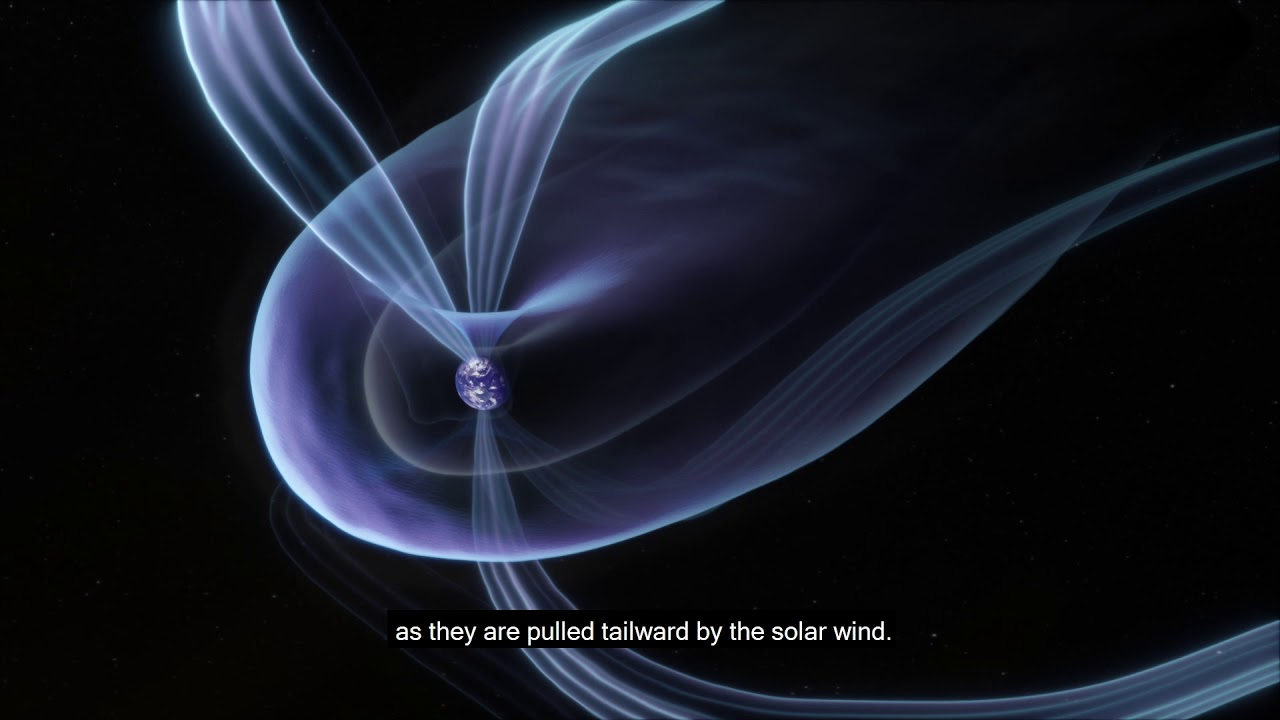
On Earth, auroras form when charged particles from the Sun are guided by our planet’s strong magnetic field toward the poles. There, they collide with oxygen and nitrogen atoms, releasing energy as visible light. This process requires three main ingredients:
- A strong global magnetic field
- A relatively thick atmosphere
- Continuous solar particle input
Mars, at first glance, seems to lack two of these.
Mars lost its global magnetic field billions of years ago. Its atmosphere is extremely thin—about 100 times thinner than Earth’s. For decades, scientists assumed these conditions ruled out auroras entirely.
That assumption turned out to be wrong.
How Scientists First Detected Auroras On Mars
The MAVEN Mission Breakthrough
The turning point came with NASA’s MAVEN (Mars Atmosphere and Volatile EvolutioN) mission, which began orbiting Mars in 2014. MAVEN’s primary goal was to understand how Mars lost most of its atmosphere over time.
While analyzing ultraviolet emissions in the planet’s upper atmosphere, researchers noticed strange patterns that intensified during solar storms. These emissions didn’t match airglow, dust reflections, or known atmospheric chemistry.
Eventually, scientists realized they were seeing auroras—just not the kind found on Earth.
Real-life analogy:
Imagine expecting fireworks only over a stadium, but instead seeing flashes appear randomly across an entire city. That’s how Martian auroras compare to Earth’s polar light shows.
What Martian Auroras Actually Look Like
Unlike Earth’s auroras, Martian auroras are invisible to the human eye. They shine almost entirely in ultraviolet wavelengths, meaning they can only be detected by spacecraft instruments.
Their key visual characteristics include:
- No green, red, or purple visible colors
- No curtain-like structures
- Patchy, planet-wide glow
- Short-lived flashes during solar storms
Instead of dancing across the sky, Martian auroras appear as brief atmospheric reactions—more like flashes than displays.
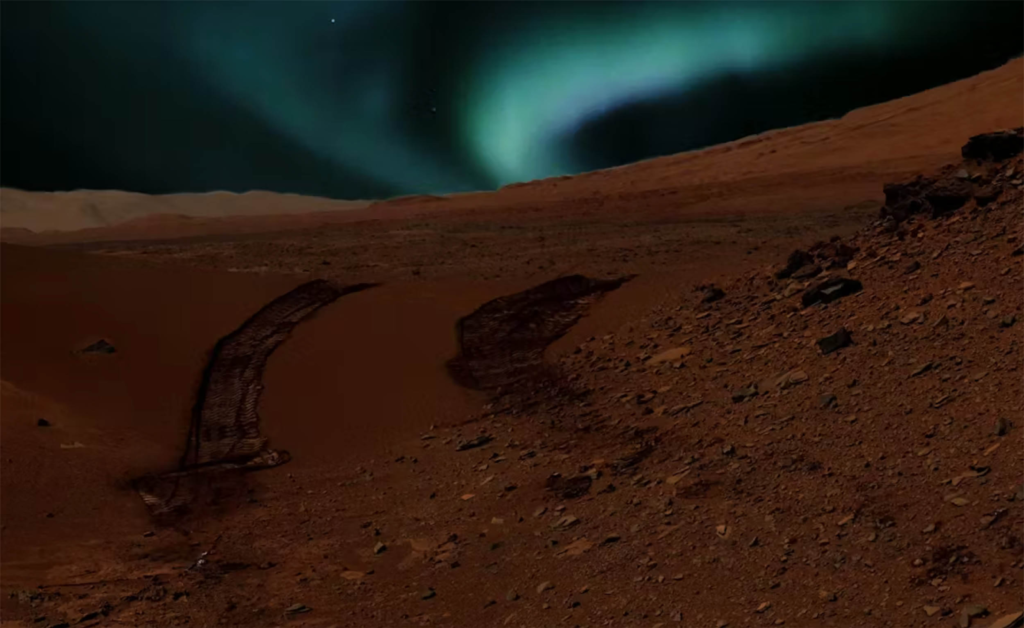
Why Mars Auroras Look Nothing Like Earths
The Magnetic Field Difference Changes Everything
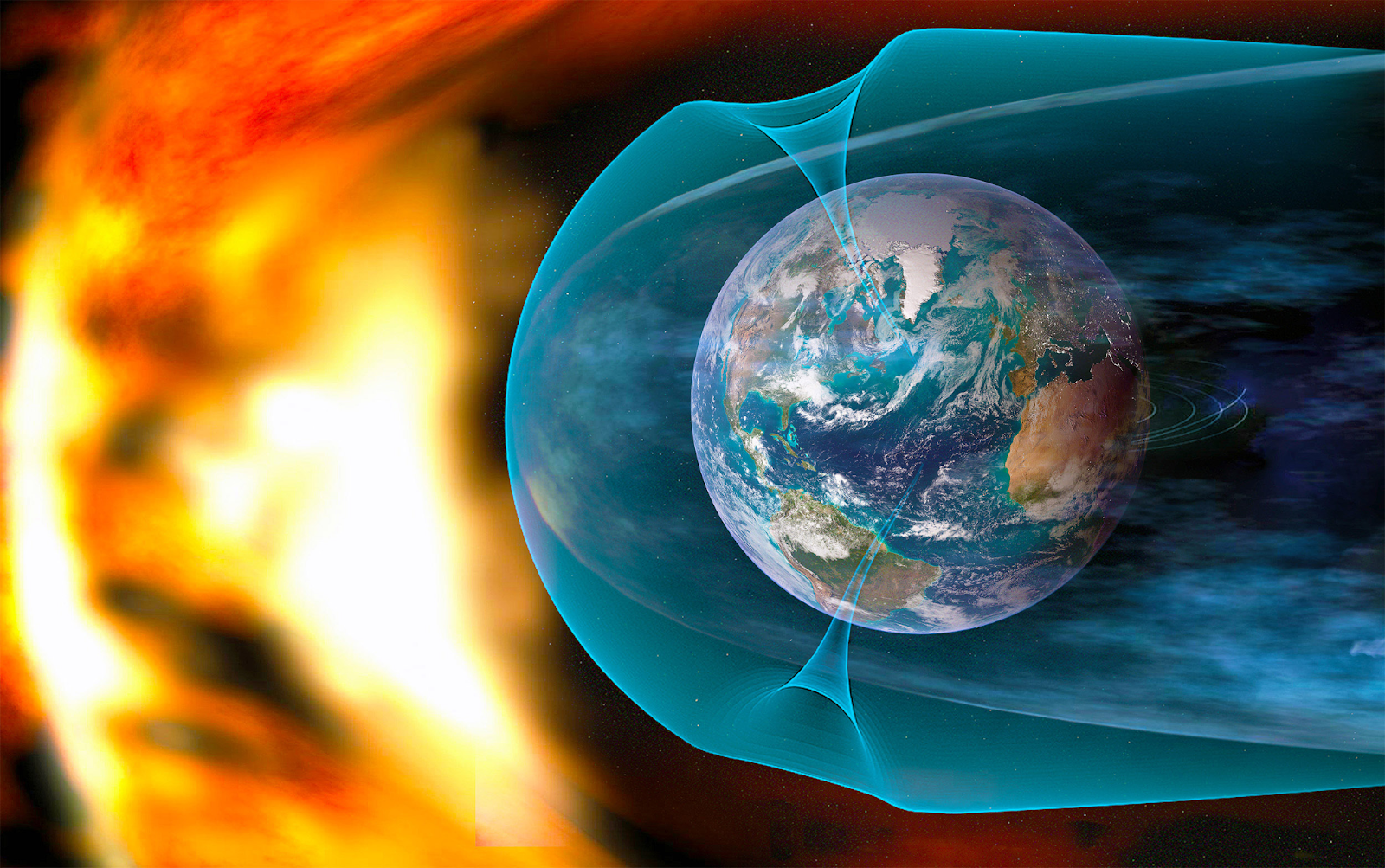
Earth’s magnetic field acts like a funnel, guiding solar particles into specific regions. Mars has no such protection.
Instead, Mars possesses localized magnetic patches embedded in its crust—fossil remnants of an ancient magnetic field that shut down billions of years ago.
These patchy fields create chaotic interactions with incoming solar particles.
As a result:
- Auroras form wherever solar particles strike the atmosphere
- There is no polar concentration
- Activity can occur almost anywhere on the planet
Mars is the only known planet where auroras can appear globally rather than near poles.
What Triggers Auroras On Mars
Martian auroras are tightly linked to solar storms.
When the Sun releases a coronal mass ejection—a massive cloud of charged particles—Mars has little defense. Solar particles slam directly into its upper atmosphere.
Scientists have observed that:
- Strong solar storms cause global auroras
- Moderate storms produce localized emissions
- Increased solar wind pressure intensifies auroras
Real-life example:
During major solar storms that caused auroras over North America, MAVEN recorded simultaneous auroral activity on Mars—two planets reacting to the same solar outburst.
The Three Types Of Auroras Found On Mars
Research has identified three distinct types of Martian auroras, each revealing different aspects of Mars’ environment.
Discrete Auroras
- Occur near crustal magnetic regions
- Most similar to Earth’s auroras
- Confined to specific locations
Diffuse Auroras
- Spread across much of the planet
- Triggered by solar energetic particles
- Common during strong solar storms
Proton Auroras
- Occur on the sunlit side of Mars
- Caused by solar wind protons
- Completely unlike Earth’s nighttime auroras
Together, these types make Mars a unique laboratory for auroral science.
Why Martian Auroras Matter Scientifically
Auroras are more than light shows—they are diagnostic tools.
By studying auroras, scientists learn how:
- Energy enters a planet’s atmosphere
- Atmospheric particles escape into space
- Magnetic fields protect—or fail to protect—planets
On Mars, auroras directly reveal how solar energy strips away atmospheric gases.
Over billions of years, this process helped transform Mars from a warmer, wetter world into the cold, thin-aired planet we see today.
What Martian Auroras Reveal About Mars’ Past
Evidence suggests Mars once had:
- Liquid water on its surface
- A thicker atmosphere
- A global magnetic field
When Mars’ magnetic field shut down, solar wind began eroding its atmosphere.
Auroras are living proof of that vulnerability.
Each auroral event shows solar particles penetrating deep into Mars’ atmosphere—something Earth’s magnetic field largely prevents.
Could Humans Ever See Auroras On Mars
This is one of the most common questions.
Because Martian auroras glow in ultraviolet light:
- Human eyes cannot see them naturally
- Special sensors or visors would be required
- Cameras could capture translated images
Future astronauts may “see” Martian auroras through augmented reality displays that convert ultraviolet signals into visible colors.
Real-life analogy:
Just as thermal cameras reveal invisible heat on Earth, future Mars explorers may visualize auroras hidden from natural sight.
How Mars Auroras Compare To Other Planets
Auroras exist throughout the solar system, but Mars is unique.
- Earth: Polar, colorful, magnetically guided
- Jupiter: Massive, extremely powerful auroras
- Saturn: Elegant auroral rings
- Mars: Scattered, ultraviolet, magnetically exposed
Mars proves that auroras do not require strong planetary protection—only solar energy and an atmosphere.
Why This Discovery Captivates The Public
Mars already fascinates people due to:
- Robotic exploration
- Plans for human missions
- The search for ancient life
Auroras add an emotional dimension. They make Mars feel active and responsive rather than static.
For many Americans, knowing that Mars glows during solar storms makes the planet feel more familiar—and more reachable.
How Scientists Study Auroras On Another Planet
Studying Martian auroras requires creative science.
Researchers combine:
- Ultraviolet spectrometers
- Plasma and particle detectors
- Solar wind monitors
- Computer simulations
By linking MAVEN data with solar observations near Earth, scientists build a complete Sun–Mars interaction model.
This multi-planet perspective is one of modern space science’s greatest strengths.
What Martian Auroras Mean For Future Human Missions
Auroras are not just beautiful—they signal danger.
Solar storms that cause auroras can also:
- Increase radiation exposure
- Disrupt communications
- Damage electronics
Understanding Martian auroras helps engineers design safer habitats, suits, and spacecraft for future astronauts.
Could Early Earth Have Had Mars-Like Auroras
Some scientists believe early Earth—before its magnetic field fully stabilized—may have experienced auroras similar to Mars’.
Studying Mars helps researchers understand:
- Planetary evolution
- Atmospheric loss
- Conditions needed for habitability
Mars may represent an alternate version of Earth’s early history.
10 Frequently Asked Questions About Auroras On Mars
Does Mars really have auroras
Yes confirmed by NASA and multiple studies
Why don’t Martian auroras look like Earth’s
Mars lacks a global magnetic field and thick atmosphere
Can humans see auroras on Mars
Not without special instruments
Are Martian auroras dangerous
They indicate solar storms and radiation exposure
How often do auroras occur on Mars
Frequently during solar activity
Where do auroras appear on Mars
Almost anywhere on the planet
Are Martian auroras colorful
Mostly ultraviolet not visible colors
Which mission discovered them
NASA’s MAVEN mission
Do auroras strip Mars’ atmosphere
Yes they are linked to atmospheric loss
Will auroras affect human Mars missions
Yes they influence radiation safety planning
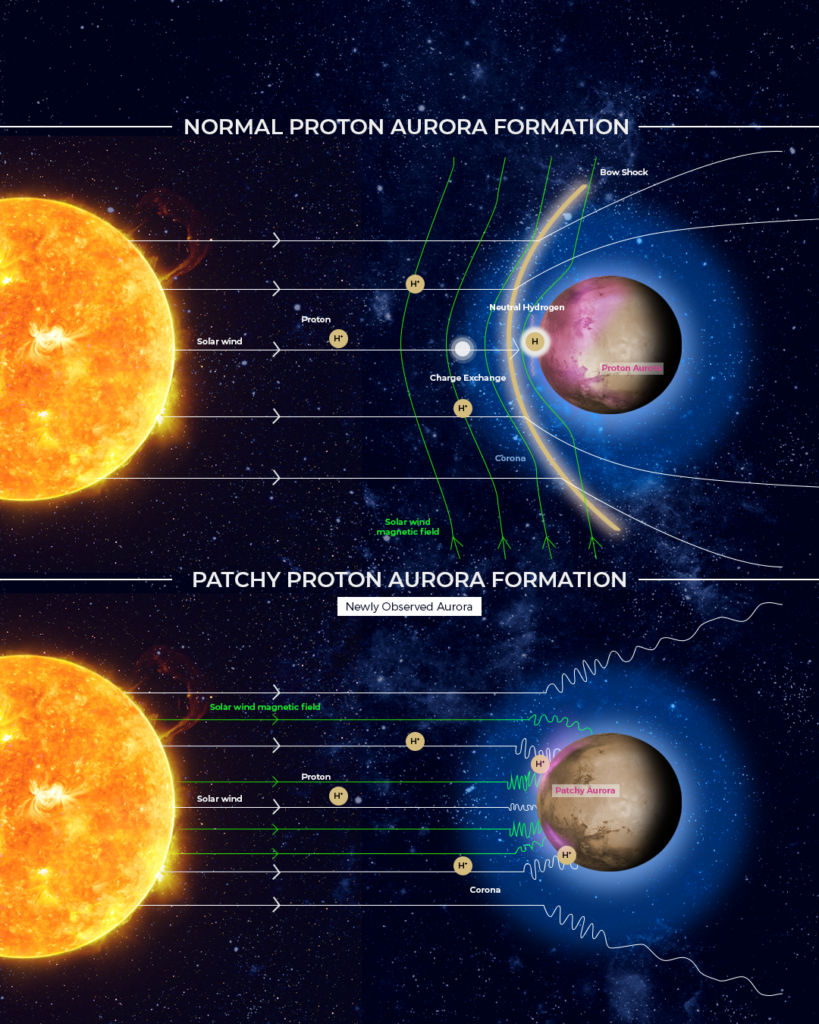
Why This Discovery Changes Planetary Science
Mars’ auroras challenge a long-standing assumption: that auroras require strong planetary protection.
Instead, they show that auroras can also be signs of exposure and vulnerability.
They reveal a planet interacting directly with its star—absorbing energy, losing atmosphere, and evolving over time.
This insight shapes how scientists evaluate exoplanets, habitability, and the future of worlds beyond Earth.
Final Takeaway
Mars does have auroras—but they are nothing like Earth’s Northern Lights.
They are invisible, scattered, and shaped by exposure rather than protection. Yet in their strange glow, they tell a powerful story about planetary evolution, solar violence, and the delicate balance that makes Earth livable.
When Mars lights up under a solar storm, it reminds us just how rare—and how protected—our own world truly is.