I never expected to see the Northern Lights without traveling far north—until one unexpected night changed everything. This firsthand account explains what triggered a rare aurora event, why it appeared outside its usual range, and how ordinary Americans are suddenly seeing it too. Blending real experience, science-backed insights, and practical advice, this guide shows how you might witness the aurora yourself.
Why the Northern Lights Always Felt Out of Reach
For most Americans, the Northern Lights feel like a distant fantasy. Something reserved for travel documentaries, luxury trips to Iceland, or extreme adventures in Alaska. Growing up, I never once thought I’d see the aurora with my own eyes—certainly not without boarding a plane or spending thousands of dollars.
That belief is incredibly common.
Search data shows Americans regularly asking:
- Can you see the Northern Lights in the U.S.?
- Is the aurora visible outside Alaska?
- Why are people suddenly seeing auroras farther south?
I used to assume the answer was simple: No.
Until one night quietly proved me wrong.
The Ordinary Evening That Almost Ended Like Every Other
There was nothing special about the day itself.
No trip planned. No telescope. No photography setup. Just another evening winding down like countless others before it.
I remember scrolling on my phone and briefly noticing a mention of “increased geomagnetic activity.” I didn’t give it much thought. Space weather alerts usually sound abstract—important for scientists, satellites, maybe power grids, but not something that affects regular people standing in their backyard.
Then social media started filling with strange posts.
People weren’t saying, “Look at this incredible aurora!”
They were asking questions instead.
“Is the sky supposed to look like this?”
“Anyone else seeing weird lights?”
“Am I imagining this?”
That uncertainty caught my attention.
The Moment I Stepped Outside With No Expectations
Around midnight, curiosity finally won.
I stepped outside expecting disappointment. The kind where you look up, see nothing unusual, and go back inside feeling silly for hoping.
At first, the sky looked normal. Stars scattered across a dark canvas. No flashing lights. No glowing curtains.
Then something subtle appeared.
A faint, uneven glow near the horizon. It looked like thin cloud cover reflecting distant city light—except it was moving differently. Slower. Smoother. Almost breathing.
I stared longer.
The glow strengthened.
That’s when I realized this wasn’t a trick of the light.
When the Sky Stopped Being Still
The transformation wasn’t instant. It built slowly, like a secret revealing itself only to those willing to wait.
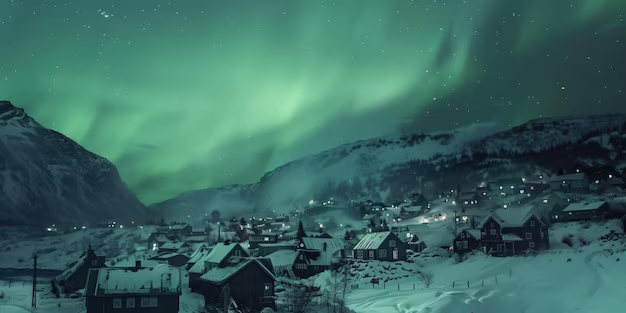
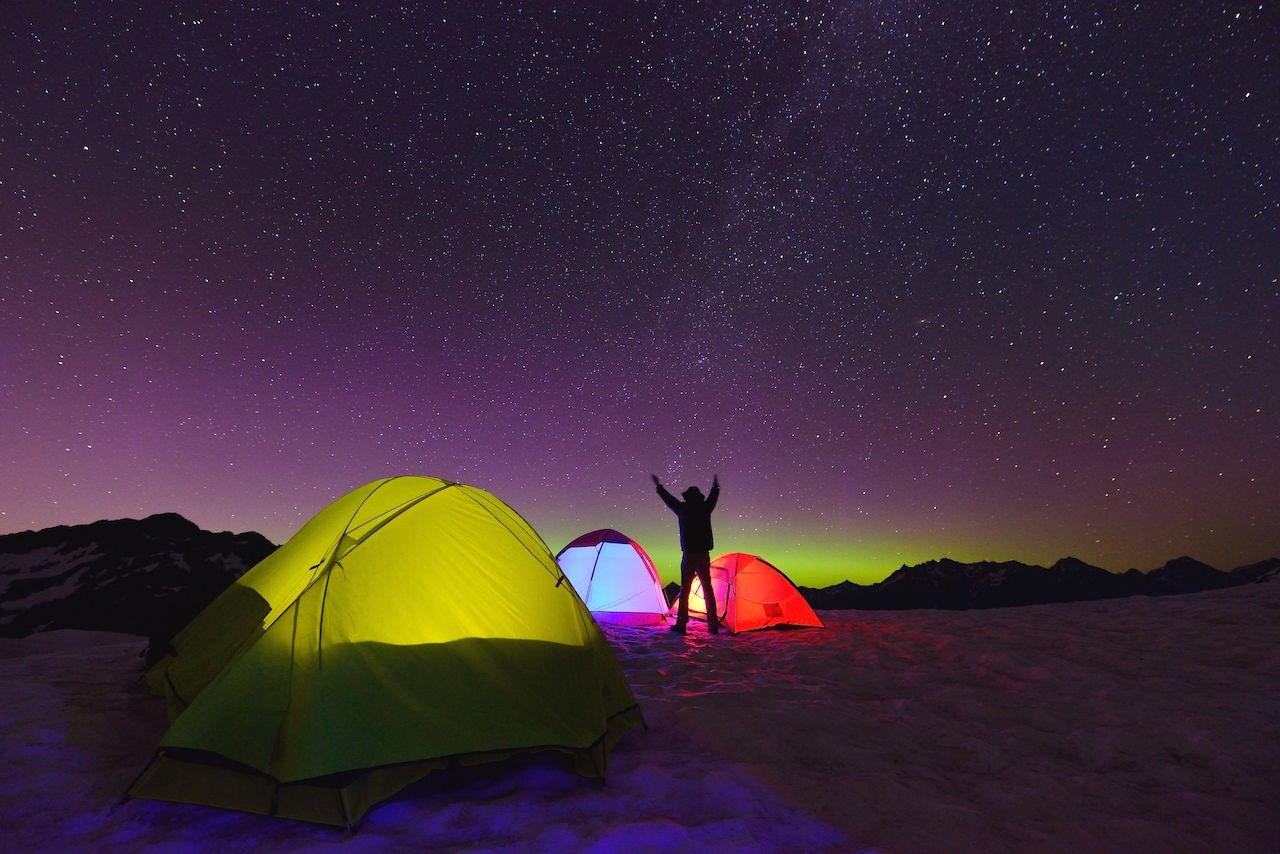
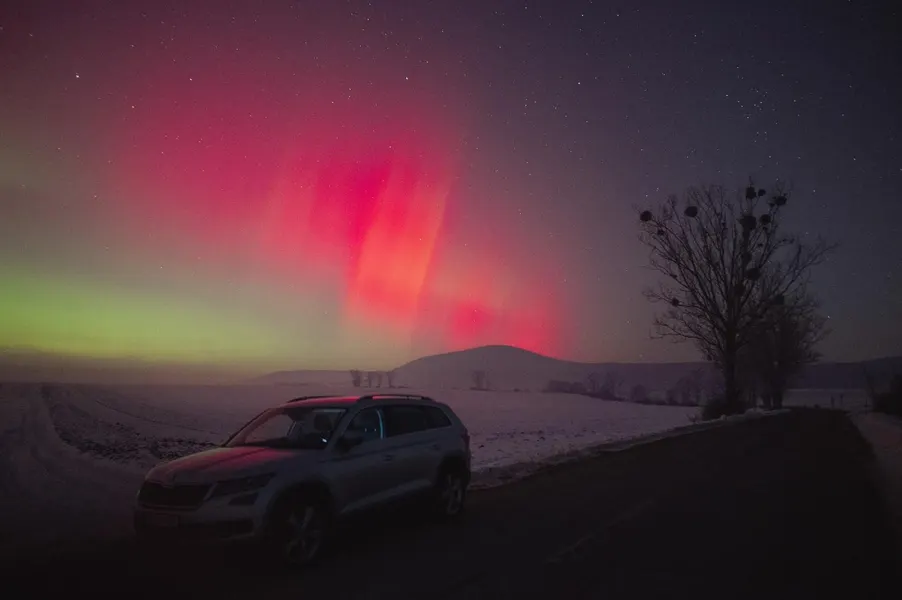
Green light stretched across the sky—not bright, not neon, but unmistakably there. Moments later, faint purple streaks appeared above it, flickering in and out like static.
Then the movement became undeniable.
The sky wasn’t glowing anymore.
It was moving.
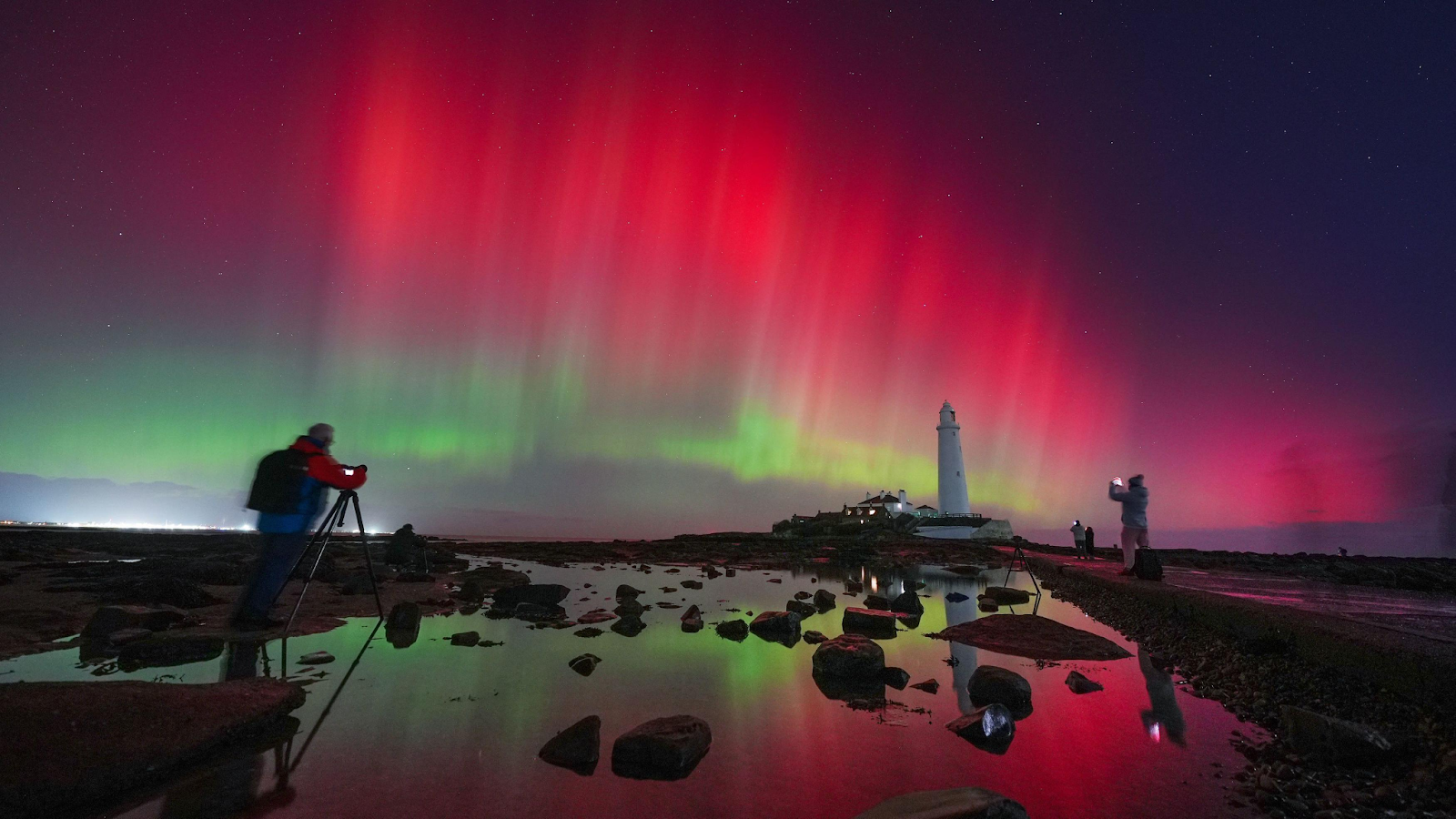
Curtains of light rippled from horizon to horizon. Shapes formed and dissolved. The aurora shifted constantly, never repeating itself, never standing still long enough to feel predictable.
That’s when it hit me.
I wasn’t watching a rare photo opportunity.
I was witnessing something alive.
Why This Aurora Event Took So Many People by Surprise
This wasn’t luck.
According to NASA and NOAA’s Space Weather Prediction Center, Earth is currently experiencing heightened solar activity due to Solar Cycle 25—an approximately 11-year cycle that governs how active the Sun becomes.
During this cycle, the Sun releases:
- More solar flares
- More coronal mass ejections (CMEs)
- Stronger streams of charged particles
When a CME is directed toward Earth, those particles collide with our planet’s magnetic field. The result is a geomagnetic storm—and when that storm is strong enough, auroras spread far beyond their usual polar boundaries.
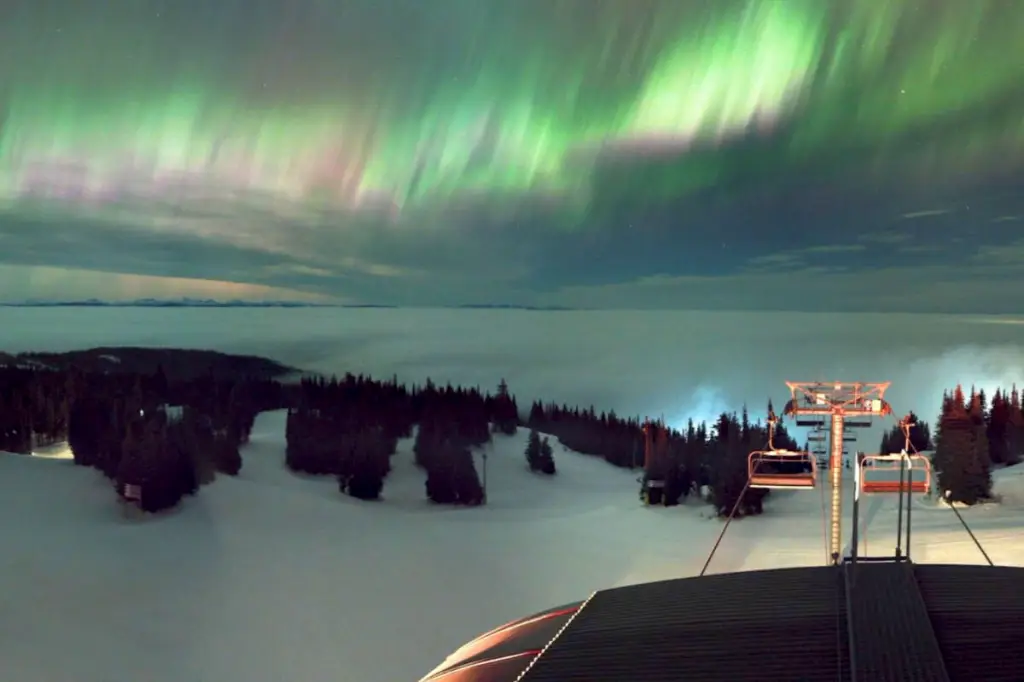
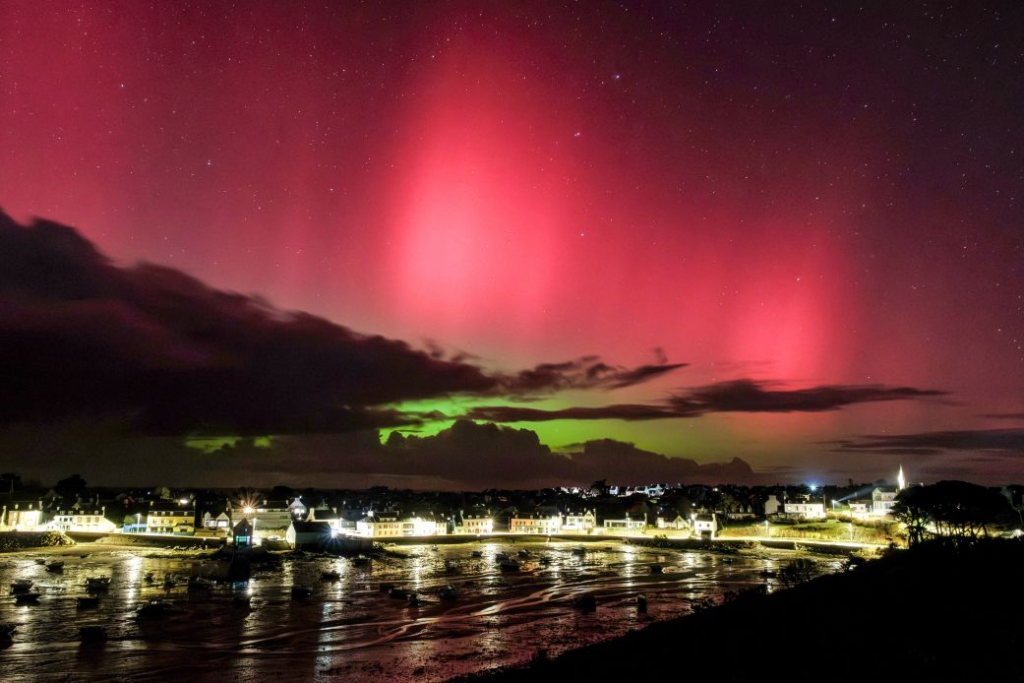
NOAA confirmed that recent storms reached G4 and G5 levels, categories considered rare and severe. These storms can push auroras thousands of miles south of where they normally appear.
That’s why so many people—myself included—were caught completely off guard.
What the Aurora Actually Looks Like in Real Life
Photos and videos don’t prepare you.
In real life, the aurora isn’t always the electric green explosion you see on Instagram. It’s more subtle, more dynamic, and far more emotional.
What stood out most:
- The motion, not the brightness
- The way the sky felt layered and deep
- The constant change—nothing stayed the same for more than seconds
It felt less like watching something and more like being surrounded by it.
The silence made it even more powerful. No sound. No vibration. Just the slow, deliberate movement of light across the entire sky.
Why Cameras Often See the Aurora Before You Do
One of the most common questions people ask after nights like this is:
“Why did my phone capture colors I barely noticed?”
The answer lies in how cameras work.
Modern smartphones and cameras use:
- Long exposure
- Image stacking
- Computational brightness enhancement
These techniques allow them to capture faint light that human eyes—especially unadjusted ones—may struggle to detect at first. That’s why reviewing photos or video often reveals more color than you remember seeing in the moment.
In my case, watching the video afterward was shocking. The movement was undeniable. The colors far clearer.
The aurora had been real all along.
The Video That Removed All Doubt
I almost didn’t record anything.
There’s a strange hesitation that comes with moments like this. You’re afraid that if you look away—or fumble with your phone—you’ll miss something irreplaceable.
I recorded only a short clip.
Watching it later was surreal. The rippling motion, the shifting colors, the sheer scale of it all—it confirmed what my mind was still struggling to process.
I hadn’t imagined it.
This wasn’t folklore.
This wasn’t exaggeration.
This was physics playing out above my head.
Why More Americans Are Seeing the Aurora Now
What I experienced isn’t an isolated story anymore.
According to NOAA data:
- Strong geomagnetic storms are increasing in frequency
- Aurora visibility zones are expanding
- Solar Cycle 25 is stronger than early forecasts predicted
Scientists expect heightened activity through 2026, meaning more chances for auroras across the continental U.S.
That’s why:
- News outlets are issuing aurora alerts more often
- Social media is filled with first-time sightings
- People in unexpected states are sharing disbelief
The Northern Lights are no longer a distant myth for Americans. They’re becoming a shared experience.
Where People Are Seeing the Aurora (That Still Feels Unreal)
Recent confirmed sightings have occurred in:
- Minnesota
- Michigan
- North Dakota
- Montana
- Maine
- Idaho
During extreme events, auroras have even been documented in:
- Texas
- Alabama
- Georgia
- Arizona
These southern sightings are rare—but scientifically verified.
Why So Many People Miss the Aurora Even When It Happens
Another question Americans ask is:
“Why didn’t I see anything when others did?”
Common reasons include:
- Light pollution washing out faint displays
- Cloud cover blocking the sky
- Not staying outside long enough
- Leaving before peak activity
Auroras often intensify after midnight, when many people have already gone to bed.
Patience is the difference between missing it and witnessing something unforgettable.
How to Increase Your Chances of Seeing the Aurora
You don’t need special equipment or expert knowledge—but preparation helps.
Practical Tips That Actually Work
- Get away from city lights if possible
- Check NOAA space weather forecasts
- Prioritize clear skies over high alert numbers
- Let your eyes adjust to darkness for 20–30 minutes
- Scan the entire sky, not just the northern horizon
During strong storms, auroras can appear overhead or even toward the south.
Why This Experience Felt So Personal
What surprised me most wasn’t the science—it was the emotion.
Standing under the aurora, I felt small but connected. Insignificant yet part of something enormous.
I understood why ancient cultures believed the lights were messages from the heavens. Even with modern explanations, the experience feels deeply human.
It reminds you that Earth isn’t isolated. We are constantly interacting with the Sun in ways we rarely notice—until nights like this make it impossible to ignore.
Is This the Best Time in Decades to See the Aurora?
According to NASA and NOAA scientists, yes.
Solar Cycle 25 is approaching its peak, which historically brings:
- More solar flares
- Stronger geomagnetic storms
- Wider aurora visibility
Experts compare current activity to some of the most active periods of the early 2000s.
If you’ve ever hoped to see the aurora without traveling internationally, this may be your best opportunity in decades.
Common Myths About the Northern Lights
Myth vs. Reality
- Myth: Auroras are always bright neon green
Reality: They often start faint and subtle - Myth: You need expensive equipment
Reality: Naked-eye viewing is enough - Myth: Auroras only happen near the Arctic
Reality: Strong storms push them far south
Why This Night Changed How I See the Sky Forever
After that night, the sky no longer feels static.
Every clear evening holds possibility.
Every space-weather alert feels personal.
I now understand that something extraordinary can happen above us at any time—and we often miss it simply because we’re not looking.
Frequently Asked Questions (Trending Searches)
1. Can you really see the aurora in the U.S.?
Yes, during moderate to strong geomagnetic storms.
2. What caused this aurora event?
A powerful coronal mass ejection from the Sun.
3. Do auroras make noise?
Scientifically unproven, though rare reports exist.
4. What time is best to see the aurora?
Typically between 10 PM and 3 AM.
5. Why do auroras look gray sometimes?
Human eyes struggle with color in low light.
6. Are auroras dangerous?
No. They occur far above Earth’s surface.
7. Can children safely watch the aurora?
Yes. No protection is required.
8. Do cameras exaggerate aurora colors?
They enhance faint light but don’t fake it.
9. Will auroras happen again soon?
Yes, solar activity remains high through 2026.
10. Do I need to travel far north to see the aurora?
Not always—timing and conditions matter more.
Final Thoughts: I Didn’t Think I’d See the Aurora—Until I Did
I almost stayed inside.
I almost ignored the alert.
I almost missed it.
That night reminded me that extraordinary moments don’t always require extraordinary travel—just awareness, patience, and a willingness to step outside.
If you ever see an aurora alert and think, “That won’t happen here,” remember this:
I thought the same thing.